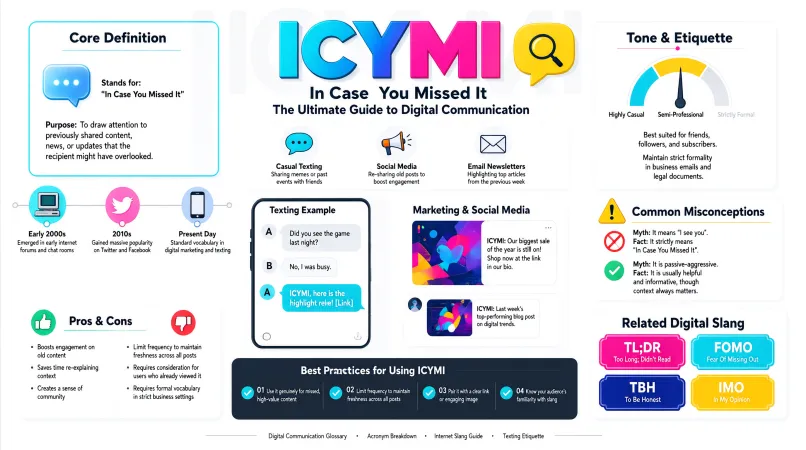
ICYMI means “In Case You Missed It.”
In a text message, ICYMI tells the reader that the information may have been shared earlier or may already be available somewhere else.
For example:
“ICYMI, the meeting was moved to Friday.”
This means:
“In case you missed it, the meeting was moved to Friday.”
The sender is giving you another chance to see the information.
ICYMI is often placed at the beginning of a message, followed by a comma, colon, dash, or the information itself.
Simple Examples
- “ICYMI, the game starts at 7.”
- “ICYMI: Our new video is live.”
- “ICYMI, the deadline is now Monday.”
- “ICYMI — here are yesterday’s photos.”
- “ICYMI, she posted an update this morning.”
In every example, the basic idea is the same: you may have missed something, so the sender is bringing it to your attention.
What Does ICYMI Stand For?
ICYMI stands for:
I — In
C — Case
Y — You
M — Missed
I — It
So:
ICYMI = In Case You Missed It
It is often called an acronym in everyday language. More precisely, it is an initialism because people normally say each letter separately rather than pronouncing it as one word.
The important part, however, is the meaning. When you see ICYMI online, think:
“Here is something you may have missed.”
What Does ICYMI Mean in a Text Message?
The ICYMI meaning in a text message is usually a friendly reminder or a way to share something again.
Imagine your friend sent an announcement in a group chat earlier. You were not online at the time. Later, your friend sends:
“ICYMI, dinner is at 8 tonight.”
They are not necessarily saying you did anything wrong. They are simply making sure you see the update.
It can also be used when someone wants to share something interesting:
“ICYMI, this video from yesterday is hilarious.”
Here, ICYMI means that the video was already posted or discussed, but you might not have seen it.
Why Do People Use ICYMI?
Online conversations move quickly. Messages, posts, videos, and announcements can disappear from view within minutes or hours.
People use ICYMI because it is a short way to bring attention back to something.
Common reasons include:
1. To Share an Earlier Update
Someone may have already posted information but wants more people to see it.
Example:
“ICYMI, the school event has been moved to Saturday.”
2. To Remind Someone
It can act as a quick reminder without writing a long message.
Example:
“ICYMI, your appointment is at 3 PM tomorrow.”
3. To Reshare Interesting Content
People may use ICYMI before a funny video, photo, article, or post.
Example:
“ICYMI, check out this funny clip.”
4. To Highlight News
News websites, organizations, and social media accounts may use it when bringing attention back to an earlier story.
Example:
“ICYMI: Here are the biggest stories from this week.”
5. To Catch People Up
In a group conversation, ICYMI can help someone who was away understand what happened.
Example:
“ICYMI, we decided to meet at the new restaurant instead.”
ICYMI Meaning on Social Media
On social media, ICYMI is especially common.
You may see it on platforms such as social networks, in captions, comments, posts, newsletters, and online communities.
The meaning stays the same:
“In Case You Missed It.”
A creator might write:
“ICYMI: Our latest video is now available.”
A company might post:
“ICYMI: We announced our new product yesterday.”
A sports account might write:
“ICYMI: Here are the highlights from last night.”
The term tells readers that the content is not necessarily brand-new. Instead, it is being highlighted again for people who may have missed it.
That idea is also reflected in dictionary definitions of ICYMI, which describe it as a written abbreviation used when posting something that is not new.
ICYMI Meaning on Instagram
On Instagram, ICYMI can appear in captions, Stories, comments, or messages.
For example:
“ICYMI, we shared the full photo set yesterday.”
The sender wants you to look at content you may have missed.
It can also be used with announcements:
“ICYMI: Tickets are now available.”
The phrase does not change meaning just because it is on Instagram. The platform only changes the context.
ICYMI Meaning on X
ICYMI is also commonly used on X when someone shares an older post, article, announcement, or news item again.
For example:
“ICYMI: Here’s our interview from yesterday.”
This tells readers that the interview was already published but may have been overlooked.
The phrase works well on fast-moving platforms because people can easily miss older posts.
ICYMI Meaning in Emails
You may also see ICYMI in email subject lines or newsletters.
For example:
“ICYMI: Our New Product Is Here”
or:
“ICYMI: Important Updates From This Week”
In an email, ICYMI often introduces information that was previously announced.
It can be casual or professional depending on the audience.
For example, a marketing newsletter may use it naturally:
“ICYMI, our summer collection launched this week.”
But in a very formal business letter, it may be better to write the full phrase:
“In case you missed it, our latest report is now available.”
Is ICYMI Formal or Informal?
ICYMI is generally informal or conversational.
It is common in:
- Text messages
- Social media
- Group chats
- Online communities
- Newsletters
- Marketing posts
- Casual workplace chats
It can also appear in professional communication, especially online. However, it may not be the best choice for highly formal writing.
For a formal letter, academic paper, or official document, writing “In case you missed it” may be clearer.
Simple Rule
Use ICYMI when the conversation is casual or digital.
Use “In case you missed it” when you want a more formal tone.
Is ICYMI Rude?
Usually, no. ICYMI is normally neutral or friendly.
For example:
“ICYMI, the deadline changed to Friday.”
That sounds like a helpful reminder.
However, tone depends on context. The same abbreviation can sound different depending on the words around it.
Compare:
“ICYMI, here’s the update you asked for.”
This sounds helpful.
With:
“ICYMI, I already told you this yesterday.”
This could sound annoyed or passive-aggressive.
So ICYMI itself is not rude. The surrounding message determines the tone.
Does ICYMI Mean “Just So You Know”?
Sometimes, ICYMI can feel similar to “just so you know,” but they are not exactly the same.
ICYMI usually points to something that may have already been shared.
Just so you know usually introduces information that the sender wants you to be aware of, whether or not it was previously shared.
For example:
“ICYMI, the event starts at 6.”
This suggests the event time may have been mentioned before.
But:
“Just so you know, the event starts at 6.”
This does not necessarily suggest that the information was shared earlier.
ICYMI vs. FYI
One common question is the difference between ICYMI and FYI.
ICYMI
ICYMI = In Case You Missed It
It usually points to information that was already shared or published.
FYI
FYI = For Your Information
It introduces information that the sender wants you to know.
For example:
ICYMI: The schedule changed yesterday.
FYI: The schedule changes tomorrow.
A simple way to remember the difference is:
ICYMI = You may have missed this.
FYI = You should know this.
ICYMI vs. TL;DR
ICYMI and TL;DR have different purposes.
ICYMI means “In Case You Missed It.”
TL;DR means “Too Long; Didn’t Read.”
ICYMI usually brings attention back to information that was previously shared.
TL;DR usually gives a short summary of a longer piece of content.
For example:
“ICYMI: The full report was published yesterday.”
versus:
“TL;DR: The report says sales increased this year.”
A useful memory trick is:
- ICYMI: You missed the content.
- TL;DR: You do not want to read all of it.
ICYMI vs. PSA
Another similar term is PSA, which means Public Service Announcement.
PSA is usually used to make an announcement or give information to a group.
For example:
“PSA: The library closes at 5 today.”
ICYMI is different because it suggests that the information may have already been shared.
“ICYMI: The library closing time was announced yesterday.”
How to Use ICYMI Correctly
Using ICYMI is easy.
Put it near the beginning of your message and then explain what the reader may have missed.
Basic Format
ICYMI + information
For example:
“ICYMI, the event starts at 6 PM.”
You can also use a colon:
“ICYMI: The new video is live.”
Or a dash:
“ICYMI — registration closes Friday.”
All three styles are easy to understand.
Keep the Message Clear
Do not use ICYMI just to make a message look trendy. The phrase works best when there is a real reason to bring something back to the reader’s attention.
Instead of:
“ICYMI, hi!”
Use it for something meaningful:
“ICYMI, the meeting time changed to 2 PM.”
ICYMI Text Examples
Here are some natural examples you may see in everyday conversations.
Example 1: Friend
Alex: “ICYMI, we’re meeting at 7 instead of 6.”
Sam: “Thanks! I didn’t see the earlier message.”
Example 2: Group Chat
“ICYMI, the trip is now planned for Saturday.”
Example 3: Social Media
“ICYMI: We posted the full video yesterday.”
Example 4: News
“ICYMI, here are today’s top stories.”
Example 5: Workplace Chat
“ICYMI, the deadline was moved to Friday.”
Example 6: Newsletter
“ICYMI: Here are the biggest updates from this week.”
Example 7: Friend Sharing a Video
“ICYMI, you have to watch this 😂”
Example 8: Reminder
“ICYMI, your appointment starts at 10 tomorrow.”
Each example uses ICYMI to draw attention to something the reader might not have seen.
How Do You Reply to ICYMI?
There is no special reply required.
You can simply respond naturally.
If the message helped you, you could say:
- “Thanks!”
- “I missed that. Thanks for letting me know.”
- “Oh, I didn’t see it.”
- “Got it, thanks.”
- “Thanks for the reminder.”
For example:
Friend: “ICYMI, the event starts at 5.”
You: “Thanks! I didn’t see that update.”
The best response depends on the conversation.
Can You Say ICYMI Out Loud?
Yes, but it is much more common in writing.
People usually say the letters individually:
I-C-Y-M-I
However, in normal speech, many people would simply say:
“In case you missed it.”
That is because ICYMI is mainly useful as a short written form.
Should ICYMI Be Capitalized?
The most common form is:
ICYMI
However, you may also see:
icymi
Both forms can communicate the same meaning.
Uppercase is common because the term is made from the first letters of the full phrase.
In casual texting, lowercase versions may appear because people often type quickly.
The capitalization does not normally change the meaning.
Is ICYMI Still Used?
Yes. ICYMI continues to appear in online communication, including social media, text messages, newsletters, and other digital content. Current dictionary references also recognize it as a standard written abbreviation.
Its usefulness is simple: online information moves quickly, and people often miss posts or updates.
Instead of writing:
“I am sharing this again because you may not have seen it when I posted it earlier.”
someone can simply write:
“ICYMI:”
That makes the message shorter and easier to scan.
People Also Ask About ICYMI
What does ICYMI mean in texting?
ICYMI means “In Case You Missed It.” In texting, it is used to point someone toward information they may not have seen earlier.
What does ICYMI mean on social media?
On social media, ICYMI means “In Case You Missed It.” It often appears before an older post, news item, video, announcement, or other content that someone wants people to see again.
Is ICYMI slang?
ICYMI is commonly treated as internet slang or an online abbreviation. More precisely, it is an initialism for “In Case You Missed It.”
Is ICYMI rude?
Usually not. ICYMI is generally a neutral or helpful expression. However, the rest of the message can make it sound annoyed or sarcastic.
What is the difference between ICYMI and FYI?
ICYMI means “In Case You Missed It,” while FYI means “For Your Information.” ICYMI often points to previously shared information, while FYI simply gives information.
What is the difference between ICYMI and TL;DR?
ICYMI points you toward something you may have missed. TL;DR provides a short version of something that is long or detailed.
Can I use ICYMI in a work message?
Yes, especially in casual workplace chats, newsletters, and online communication. For very formal messages, writing “In case you missed it” may be better.
How do you use ICYMI in a sentence?
You can put it at the start of a message, such as: “ICYMI, the meeting has been moved to Friday.”
What does ICYMI stand for?
ICYMI stands for “In Case You Missed It.”
How do you pronounce ICYMI?
It is normally read letter by letter: I-C-Y-M-I. In spoken conversation, people often say the full phrase instead.
ICYMI Meaning: Quick Summary
| Term | Meaning | Common Use |
| ICYMI | In Case You Missed It | Resharing or highlighting information |
| FYI | For Your Information | Giving information |
| TL;DR | Too Long; Didn’t Read | Giving a short summary |
| PSA | Public Service Announcement | Sharing an announcement |
| BTW | By The Way | Adding another point |
The easiest one to remember is:
ICYMI = In Case You Missed It.
When someone uses it, they are usually saying that something may have escaped your attention and is worth checking.
Article Summary
ICYMI means “In Case You Missed It.” It is a common internet abbreviation used in texts, social media posts, emails, newsletters, and online chats. People use it to highlight information that someone may not have seen earlier.
It can introduce an old post, news update, announcement, reminder, video, article, or other useful content. The phrase is usually friendly and informal, although the tone can change depending on the rest of the message.
ICYMI is different from FYI because ICYMI often suggests that the information was previously shared, while FYI simply gives information. It is also different from TL;DR, which provides a short summary of longer content.
In simple words, whenever you see ICYMI, think:
“Here is something you may have missed.”
Conclusion
The ICYMI meaning in texts is simple: “In Case You Missed It.” You will often see it before a reminder, update, post, video, news story, or announcement.
It is mainly used to bring attention back to information that may have been overlooked. You can use it in texts, group chats, social media captions, newsletters, and casual workplace messages.
For example:
“ICYMI, the event starts at 7 PM.”
The sender is simply saying that you may not have seen the information earlier.
So the next time you see ICYMI, you will kn

Olivia Bennett is a dedicated content writer passionate about slang, word meanings, and digital communication. She creates simple and helpful content to make language easy for everyone to understand.