HBU stands for “How About You?”
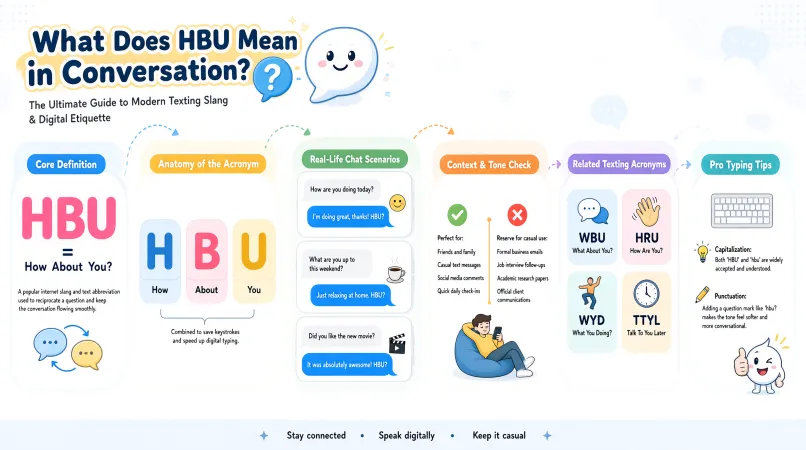
It is a casual texting abbreviation used to return a question to another person. Usually, one person shares something about themselves, then adds “HBU?” to invite the other person to share the same type of information.
For example:
Person 1: I’m having a pretty good day. HBU?
Meaning: I’m having a pretty good day. How about you?
Another example:
Person 1: I’m staying home tonight. HBU?
Meaning: I’m staying home tonight. What about you?
The basic idea is simple: HBU gives the question back to the other person. Current slang references and recent explanations of HBU describe it as a casual way to ask for the other person’s answer, opinion, or status in return.
HBU Meaning at a Glance
| Term | Meaning | Tone | Common Use |
| HBU | How About You? | Casual | Texting and chats |
| WBU | What About You? | Casual | Texting and chats |
| HBY | How About You? | Casual | Less common variation |
| How about you? | Full phrase | Neutral/casual | Everyday conversation |
What Does HBU Stand For?
The letters in HBU represent:
- H = How
- B = About
- U = You
Together, they form “How About You?”
In casual texting, people often shorten common phrases to save time and keep messages quick. HBU is an example of this type of texting shorthand.
You may see it written as:
- HBU?
- hbu?
- Hbu?
- hbu
The capitalization usually does not change the meaning.
For example:
I’m good, hbu?
means:
I’m good. How about you?
What Does HBU Mean in Text Messages?
In text messages, HBU normally means “How About You?”
Someone may use it after answering a question or giving you an update.
Example 1: Asking About Your Day
Text:
“I had a really busy day. HBU?”
Meaning:
“I had a really busy day. How was your day?”
Example 2: Talking About Food
Text:
“I’m having pizza tonight, hbu?”
Meaning:
“I’m having pizza tonight. What are you having?”
Example 3: Talking About Plans
Text:
“I’m going to the mall later. HBU?”
Meaning:
“I’m going to the mall later. What are your plans?”
Example 4: Talking About School
Text:
“I have a test tomorrow. HBU?”
Meaning:
“I have a test tomorrow. Do you have one too?”
The exact question depends on the conversation. HBU does not have to refer only to how someone feels. It can ask about their plans, opinion, situation, or answer.
Why Do People Use HBU?
People use HBU because it is short and easy.
Instead of writing:
“I’m doing well. How about you?”
someone can write:
“I’m doing well. HBU?”
This makes the conversation faster without changing the basic meaning.
HBU can also help keep a conversation going. If someone tells you something about themselves and then writes “HBU?”, they are giving you a chance to respond.
For example:
Friend: I’m watching a movie. HBU?
You can answer:
You: I’m studying right now.
The abbreviation works like a quick conversational handoff.
Is HBU Casual or Formal?
HBU is casual and informal.
It works well in:
- Text messages
- Friend chats
- Group chats
- Social media DMs
- Casual online conversations
- Informal messages
It is usually better to avoid HBU in formal writing.
For example, you would normally not write:
“I’m available tomorrow, HBU?”
in a formal business email.
Instead, you could write:
“I’m available tomorrow. How about you?”
Or:
“I’m available tomorrow. Are you available as well?”
The full phrase sounds more appropriate when the situation is formal.
Is HBU Rude?
Usually, no. HBU is not automatically rude.
It is normally a simple way to ask another person the same question.
However, tone depends on the whole message.
Compare:
“I’m good, hbu?”
This sounds normal and casual.
But:
“Fine. HBU.”
could feel short or uninterested depending on the conversation.
The abbreviation itself is not rude. The surrounding words, punctuation, and context can affect how a message feels.
Does HBU Mean “What About You?”
Yes, in many conversations, HBU can be understood almost the same way as “What About You?”
For example:
“I like basketball. HBU?”
can mean:
“I like basketball. What about you?”
There is a small wording difference between “How about you?” and “What about you?”, but in everyday texting, both can be used to ask for the other person’s answer.
That is why WBU is another abbreviation you may see.
HBU vs. WBU
HBU and WBU are very similar.
HBU = How About You?
WBU = What About You?
Both are commonly used to return a question to another person.
Example With HBU
“I’m free this weekend. HBU?”
Meaning:
“I’m free this weekend. How about you?”
Example With WBU
“I’m free this weekend. WBU?”
Meaning:
“I’m free this weekend. What about you?”
In casual texting, the difference is usually small enough that either can work.
HBU vs. HBY
You may also see HBY, which can mean “How About You?”
For example:
“I’m feeling good today, HBY?”
The intended meaning is the same as HBU.
However, HBU is the more recognizable form in many texting contexts, while HBY may appear less often.
If you want the clearest option, simply write:
“How about you?”
How Is HBU Used in a Conversation?
HBU can be used in many everyday situations.
HBU After “How Are You?”
Someone might ask:
“How are you?”
You could reply:
“I’m doing good, HBU?”
Here, HBU means:
“How about you?”
You are answering their question and asking how they are doing too.
HBU After Talking About Plans
“I’m going out with my family tonight. HBU?”
This asks about the other person’s plans.
HBU After Sharing an Opinion
“I think that movie was great. HBU?”
Here, HBU asks for the other person’s opinion.
HBU After Talking About Food
“I had burgers for lunch. HBU?”
Here, HBU asks what the other person ate.
HBU After Talking About Hobbies
“I usually play games after school. HBU?”
This asks what the other person likes to do.
15 HBU Examples in Texting
Here are simple examples of how HBU can appear in real conversations:
- “I’m good today, hbu?”
→ How about you? - “I’m staying home tonight. HBU?”
→ What are your plans? - “I love pizza. HBU?”
→ Do you like pizza too? - “I’m watching a movie. HBU?”
→ What are you doing? - “I have class tomorrow. HBU?”
→ Do you have class too? - “I’m tired today, hbu?”
→ How are you feeling? - “I prefer summer. HBU?”
→ Which do you prefer? - “I’m going to the gym later. HBU?”
→ What are you doing later? - “I like that song. HBU?”
→ Do you like it too? - “I’m free this weekend, hbu?”
→ What are your weekend plans? - “I’m studying right now. HBU?”
→ What are you doing right now? - “My favorite subject is science. HBU?”
→ What is your favorite subject? - “I’m from Texas. HBU?”
→ Where are you from? - “I already ate dinner. HBU?”
→ Have you eaten dinner? - “I’m excited for tomorrow. HBU?”
→ Are you excited too?
These examples show an important point: HBU gets its exact meaning from the message before it.
How to Reply to HBU
When someone sends you “HBU?”, the easiest response is to answer the question they just asked.
You usually do not need to explain what HBU means.
If Someone Asks How You Are
Them: I’m doing great, HBU?
You: I’m doing good too!
If Someone Talks About Their Plans
Them: I’m going to the movies tonight, HBU?
You: I’m staying home tonight.
If Someone Shares an Opinion
Them: I think that show is really good, HBU?
You: Same! I like it too.
If You Want to Continue the Conversation
You can answer and ask another question.
Them: I’m studying right now, HBU?
You: I’m studying too. What are you working on?
This makes the conversation more natural and gives the other person something else to answer.
Can HBU Be Used by Itself?
Yes.
Someone may simply send:
“HBU?”
This means “How about you?”
The previous conversation usually provides the missing context.
For example:
Person 1: I’m doing great today.
Person 2: HBU?
Person 2 is asking:
“How about you?”
In this case, they are probably asking how Person 1 is doing.
Does HBU Have a Hidden Meaning?
Usually, no.
HBU normally has a straightforward meaning: “How About You?”
It does not automatically mean something secret or special.
However, the tone can change based on the conversation. A person may use HBU in a friendly, curious, playful, or very brief way.
The surrounding message matters more than the three letters themselves.
Does HBU Mean Someone Is Interested in You?
Not necessarily.
If someone sends:
“I’m good, hbu?”
they are simply returning the question.
It does not automatically mean they have romantic feelings or a special interest in you.
For example, friends, classmates, family members, and other people can all use HBU in normal conversations.
The best way to understand the message is to look at the full conversation, not just the abbreviation.
Can HBU Sound Flirty?
HBU itself is not a flirty abbreviation.
It can appear in a friendly or playful conversation, but the word alone does not show romantic interest.
For example:
“I’m having a great day, hbu?”
is completely normal.
The tone depends on the other messages, the relationship between the people, and the overall conversation.
So if you receive HBU, there is usually no need to read a hidden meaning into it.
Is HBU Used on Social Media?
Yes. HBU can appear in many informal online conversations.
You might see it in:
- Direct messages
- Group chats
- Comments
- Text messages
- Online communities
- Casual gaming chats
The basic meaning stays the same: “How About You?”
Recent explanations of the term also describe HBU as a common form of casual online shorthand used to keep conversations moving.
HBU Meaning on Snapchat
On Snapchat, HBU can simply mean:
“How About You?”
For example:
“I’m just chilling at home hbu?”
The person is asking what you are doing or how your situation is.
Because Snapchat conversations are usually casual, short forms such as HBU fit naturally in messages.
HBU Meaning on Instagram
On Instagram, someone might use HBU in a DM or casual conversation.
For example:
“I’m going to that event this weekend, hbu?”
They want to know whether you are going too.
Another example:
“I love this song, hbu?”
Here, they want to know your opinion.
HBU Meaning on WhatsApp
HBU can also be used in WhatsApp chats.
For example:
“I’m home now. HBU?”
This simply means:
“I’m home now. How about you?”
It can also be mixed with other casual texting styles.
For example:
“Main theek hoon, HBU?”
The English abbreviation still means “How About You?”
HBU in Casual English
HBU is best understood as conversational shorthand.
Instead of writing a complete sentence, someone uses three letters to quickly pass the question back.
This is why it often appears after:
- “I’m good.”
- “I’m tired.”
- “I’m busy.”
- “I’m free.”
- “I like it.”
- “I’m going out.”
- “I already ate.”
- “I’m watching TV.”
For example:
“I’m free tonight, HBU?”
The reader understands that the sender wants the other person’s answer.
When Should You Use HBU?
Use HBU when the conversation is casual and you want to ask the same question back.
It is a good choice when:
- You are texting a friend.
- You are chatting casually.
- You are replying to someone online.
- You want a short response.
- The other person already knows common texting abbreviations.
For example:
“I’m ready for the weekend, HBU?”
That sounds natural in a casual chat.
When Should You Avoid HBU?
Avoid HBU when you need a formal or professional tone.
For example, in:
- Formal emails
- Job applications
- School assignments
- Business letters
- Official documents
- Professional communication
use the full phrase instead.
Instead of:
“I’m available Friday. HBU?”
write:
“I’m available Friday. How about you?”
This is clearer and more appropriate in formal situations.
Common Mistakes With HBU
Mistake 1: Thinking HBU Is a Word
HBU is an abbreviation, not a normal English word.
It is short for:
How About You?
Mistake 2: Assuming It Has One Specific Question
HBU can refer to different things depending on context.
If someone says:
“I’m going out tonight, HBU?”
they are asking about your plans.
If someone says:
“I’m feeling better, HBU?”
they are asking how you feel.
Mistake 3: Using It in Formal Writing
HBU is informal. The full phrase is better for professional situations.
Mistake 4: Thinking It Is Automatically Flirty
HBU alone does not prove romantic interest. It is a general conversational abbreviation.
Other Texting Abbreviations Similar to HBU
If you are learning texting slang, you may also see:
WBU
WBU = What About You?
Example:
“I’m ready. WBU?”
HBY
HBY = How About You?
It has the same basic meaning as HBU.
WYD
WYD = What You Doing?
It usually asks what someone is doing.
Example:
“WYD tonight?”
HRU
HRU = How Are You?
It is used to ask how someone is doing.
BTW
BTW = By the Way
It introduces an extra point or topic.
Knowing these short forms can make casual online conversations easier to understand.
HBU Meaning in Simple Words
If you want the shortest possible explanation:
HBU means “How About You?”
It is used when someone wants your answer after sharing their own.
Think of it like passing a question back.
“I’m good. HBU?”
means:
“I’m good. How about you?”
That is the main idea behind HBU.
FAQs
What does HBU mean in conversation?
HBU means “How About You?” It is a casual abbreviation used to ask another person the same or a related question after sharing your own answer.
What does HBU mean in texting?
In texting, HBU means “How About You?” It is commonly used to return a question without typing the full phrase.
What should I reply when someone says HBU?
Answer the question from the previous message. For example, if someone says, “I’m doing good, HBU?” you can reply, “I’m doing good too.”
Is HBU the same as WBU?
They are very similar. HBU means “How About You?”, while WBU means “What About You?” Both are used to ask for the other person’s answer.
Is HBU formal or informal?
HBU is informal. It is best for casual texting, chats, and DMs rather than formal emails or professional writing.
Does HBU mean “How About You?”
Yes. That is the standard meaning of HBU in texting and casual online conversation.
What does lowercase “hbu” mean?
Lowercase “hbu” has the same meaning as uppercase “HBU.” Capitalization usually does not change its meaning in casual texting.
Can HBU be used after an answer?
Yes. This is one of the most common ways to use it.
Example:
“I’m free tonight, HBU?”
The person is asking about your plans.
Is HBU rude?
Usually not. HBU is normally neutral and casual. However, the tone of the complete message can affect how it feels.
Does HBU mean someone likes you?
Not by itself. HBU simply means “How About You?” It does not automatically show romantic or special interest.
Can I use HBU with friends?
Yes. HBU is well suited to casual conversations with friends and other people you know.
Can I use HBU in an email?
You can, but it is usually better to avoid it in a formal email. Write “How about you?” instead.
What does “hbu?” mean after “I’m good”?
If someone says “I’m good, hbu?”, they mean “I’m good. How about you?” They are asking how you are doing.
What does HBU mean on social media?
On social media, HBU usually means “How About You?” It can be used in DMs, comments, and other casual conversations.
What is the easiest way to remember HBU?
Remember the three letters:
H = How
B = About
U = You
So:
HBU = How About You?
Article Summary
HBU means “How About You?” It is a short, casual abbreviation used in texting and online conversations. People usually write HBU after answering a question, sharing an opinion, or giving an update. It invites the other person to share their own answer.
For example:
“I’m doing great today, HBU?”
means:
“I’m doing great today. How about you?”
HBU is similar to WBU, which means “What About You?” Both are informal and useful in casual chats. HBU is generally not rude or automatically flirty; its tone depends on the surrounding conversation.
Conclusion
The HBU mean in conversation is simple: HBU stands for “How About You?”
It is a casual texting abbreviation that lets someone return a question to you after sharing their own answer. You may see it in text messages, DMs, group chats, and other informal online conversations.
For example, “I’m good, HBU?” simply means “I’m good. How about you?”
Remember that HBU is informal, so it is best for casual conversations rather than formal writing. If you understand the message before HBU, you can usually understand exactly what the person is asking.
In short, when someone sends “HBU?”, they are usually just asking:
“How about you?”

Olivia Bennett is a dedicated content writer passionate about slang, word meanings, and digital communication. She creates simple and helpful content to make language easy for everyone to understand.