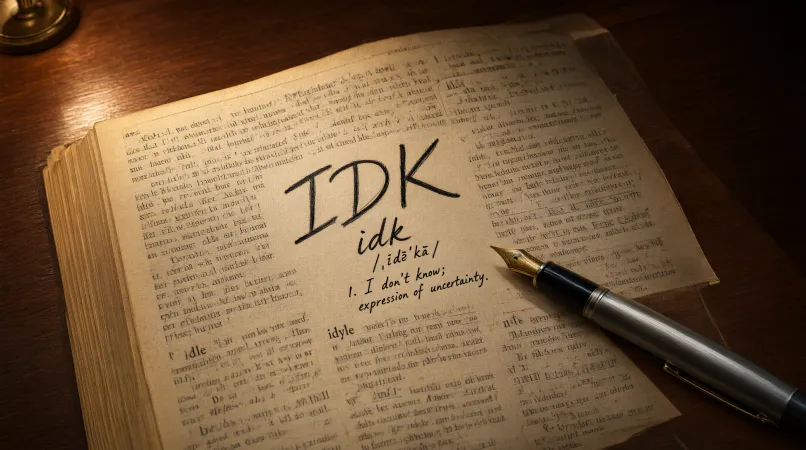
IDK stands for “I don’t know.”
It is an informal abbreviation used in texting, online chats, social media, and other casual digital conversations. It is normally read as the individual letters I-D-K.
For example:
- “What time does the movie start?”
“IDK.” - “IDK what happened.”
- “IDK if I can go tonight.”
- “IDK, you choose.”
In each example, the person is showing that they do not know, are unsure, or do not have a clear answer.
Quick Meaning of IDK
| Term | Meaning | Type |
| IDK | I don’t know | Texting abbreviation |
| idk | I don’t know | Casual lowercase form |
| IDK? | I don’t know? | Uncertainty |
| IDKKK | I really don’t know | Playful/emphatic form |
Both IDK and idk can mean the same thing. Lowercase is especially common in casual texting.
What Does IDK Mean in Text?
In text messages, IDK means “I don’t know.”
Someone may send IDK because they:
- Do not know the answer.
- Are unsure about something.
- Have not decided yet.
- Do not have enough information.
- Do not want to give a definite answer.
- Want to keep the reply short.
For example:
Person 1: “Do you know where Alex is?”
Person 2: “IDK.”
Here, IDK simply means the person does not know where Alex is.
Another example:
Person 1: “Are you coming tomorrow?”
Person 2: “IDK yet.”
Here, the person is not sure about their plans.
The basic meaning stays the same, but the reason for using it can change depending on the conversation.
What Does IDK Stand For?
IDK stands for:
I = I
D = Don’t
K = Know
Put together:
IDK = I Don’t Know
It is an initialism because the letters represent the first letters of the words. IDK became part of the shorthand used in texting and online communication.
People often use short forms like IDK because they make casual conversations faster and easier.
What Does IDK Mean on Social Media?
On social media, IDK usually has the same meaning: “I don’t know.”
You may see it in:
- Comments
- Direct messages
- Group chats
- Captions
- Replies
- Online discussions
- Gaming chats
For example:
“IDK why everyone likes this song.”
This means:
“I don’t know why everyone likes this song.”
Another example:
“IDK what to post today.”
This means:
“I don’t know what to post today.”
The abbreviation does not have a completely different meaning just because it appears on social media.
Examples of IDK in Text Messages
Here are some simple examples of how people use IDK in everyday messages.
Example 1: Not Knowing an Answer
Friend: “What time does the store close?”
You: “IDK.”
Meaning: You do not know the closing time.
Example 2: Being Unsure
Friend: “Are you going to the party?”
You: “IDK yet.”
Meaning: You have not decided.
Example 3: Not Having Information
Friend: “Why is Sam late?”
You: “IDK.”
Meaning: You do not know why Sam is late.
Example 4: Asking Someone Else to Decide
Friend: “Pizza or burgers?”
You: “IDK, you choose.”
Meaning: You do not have a strong preference.
Example 5: Showing Confusion
Friend: “Why did he leave so early?”
You: “IDK what happened.”
Meaning: You are not sure what happened.
Example 6: Casual Conversation
Friend: “What should we watch tonight?”
You: “IDK lol.”
Here, the message sounds relaxed and casual.
Can IDK Have Different Meanings?
The literal meaning of IDK is still “I don’t know,” but the feeling behind it can change.
For example:
“IDK.”
This may sound like a short or uninterested answer.
But:
“idk haha”
usually feels more relaxed or playful.
And:
“IDK 😭”
may show that the person is confused, overwhelmed, or joking about not knowing.
So, it is better to look at the whole message and conversation instead of judging the meaning from IDK alone. Tone in digital communication can depend on punctuation, emojis, and surrounding words.
Does IDK Mean “I Don’t Care”?
No.
IDK = I don’t know.
IDC = I don’t care.
These abbreviations are easy to confuse, but they have different meanings.
For example:
“IDK what movie to watch.”
= I don’t know what movie to watch.
“IDC what movie we watch.”
= I don’t care which movie we watch.
IDK shows uncertainty or a lack of information. IDC shows a lack of concern or preference.
Is IDK Rude?
IDK is not automatically rude.
The tone depends on how it is used.
For example:
“IDK, let me check.”
This sounds normal and helpful.
But:
“IDK.”
as a reply to an important question may feel short or dismissive.
A person may simply be busy, unsure, or trying to answer quickly. That is why you should consider the full conversation before assuming someone is being rude.
Some language guides also note that a bare IDK can sometimes feel dismissive when the other person expects a fuller response.
Is IDK Formal or Informal?
IDK is informal.
It is common in:
- Text messages
- Friendly chats
- Social media
- Group conversations
- Casual online messages
It is usually better to write “I don’t know” instead of IDK in formal situations such as:
- School assignments
- Formal letters
- Job applications
- Official documents
- Professional reports
- Important business communication
For example, instead of:
“IDK when the meeting starts.”
a professional message could say:
“I’m not sure when the meeting starts. I’ll check and let you know.”
This sounds clearer and more professional.
IDK vs. “I Don’t Know”
There is no difference in the basic meaning.
IDK is simply the shorter, informal version of:
“I don’t know.”
Compare these:
Texting:
“IDK what happened.”
Standard English:
“I don’t know what happened.”
Both communicate the same basic idea.
The main difference is style and setting. IDK is quicker and more casual, while “I don’t know” works in both casual and more formal communication.
What Does “IDK Yet” Mean?
“IDK yet” means “I don’t know yet.”
It tells the other person that you may know the answer later.
Example:
“Are you free Saturday?”
“IDK yet.”
This means the person has not decided or does not know their schedule yet.
Other examples include:
- “IDK yet, I’ll check.”
- “IDK yet, maybe tomorrow.”
- “IDK yet. I’ll let you know.”
This form often suggests that the answer is not known right now, rather than that the person will never know.
What Does “IDKKK” Mean?
Sometimes people add extra letters to an abbreviation for emphasis.
IDKKK still means “I don’t know,” but the extra K’s can add emotion or emphasis.
For example:
“IDKKK 😭”
may communicate something like:
“I really don’t know!”
The exact feeling depends on the conversation.
Extra letters are common in casual online communication because people use them to make short messages feel more expressive.
What Does “IDK LOL” Mean?
“IDK LOL” generally means:
“I don’t know, haha.”
The word LOL can make the message feel lighter or more playful.
Example:
“Why did I buy that? IDK LOL.”
The person is saying they do not really know why they made that choice, while also treating it as a joke.
What Does “IDK” Mean From a Girl?
If a girl sends you “IDK,” the basic meaning is still “I don’t know.”
It does not automatically mean that she is angry, upset, uninterested, or trying to avoid you.
The context matters.
For example:
“What do you want to eat?”
“IDK.”
She may simply not have a preference.
But:
“Are you okay?”
“IDK.”
could suggest uncertainty or that she does not know how she feels.
Do not try to give IDK a special meaning based only on who sent it. Look at the conversation around the message.
What Does “IDK” Mean From a Guy?
The same basic rule applies.
If a guy texts “IDK,” it normally means “I don’t know.”
It could show:
- Uncertainty
- Lack of information
- Indecision
- Confusion
- A casual response
For example:
“Are you coming with us?”
“IDK yet.”
This most likely means he has not decided.
The surrounding conversation is more important than the fact that the sender is a guy.
How Do You Reply to IDK?
Your reply depends on what the person said.
If They Genuinely Do Not Know
You can say:
- “No worries.”
- “Okay.”
- “That’s fine.”
- “Let me know when you find out.”
If They Are Deciding
You can say:
- “Take your time.”
- “You can decide later.”
- “Either option works for me.”
If You Need More Information
You can ask:
- “Can you check?”
- “Do you want me to find out?”
- “When do you think you’ll know?”
Example Conversation
You: “Are you free tomorrow?”
Friend: “IDK yet.”
You: “No problem. Let me know later.”
This keeps the conversation natural.
Common Phrases With IDK
IDK can appear in many different sentence patterns.
“IDK What…”
Used when someone does not know something.
Example:
“IDK what happened.”
“IDK If…”
Used when someone is uncertain.
Example:
“IDK if I can go.”
“IDK Why…”
Used when someone does not understand a reason.
Example:
“IDK why he left.”
“IDK When…”
Used when someone does not know a time.
Example:
“IDK when she gets home.”
“IDK Yet”
Used when an answer has not been decided or discovered.
Example:
“IDK yet, I’ll check.”
“IDK, You Decide”
Used when someone does not have a strong preference.
Example:
“IDK, you decide where we eat.”
IDK vs. Similar Texting Abbreviations
Knowing similar abbreviations can help prevent confusion.
| Abbreviation | Meaning | Main Idea |
| IDK | I don’t know | Uncertainty |
| IDC | I don’t care | Lack of concern |
| IKR | I know, right? | Agreement |
| IMO | In my opinion | Personal opinion |
| TBH | To be honest | Honest statement |
| BTW | By the way | Adds another point |
| NVM | Never mind | Drop the subject |
| WDYT | What do you think? | Asking for an opinion |
The most important difference is between IDK and IDC.
IDK: “I do not know.”
IDC: “I do not care.”
They may look similar, but they communicate different ideas.
Where Did IDK Come From?
IDK developed as part of the shorthand used in text messaging and online communication.
People began using shortened forms to make messages faster and easier to type. IDK became part of this broader style of text speak or SMS language. Grammarly notes that IDK has been part of text speak since at least the early 2000s.
Today, IDK is widely recognized in casual digital communication.
Should You Use IDK in School or Work?
It depends on the situation.
For a casual message to a friend, IDK is usually fine.
For formal writing, it is better to use the full phrase “I don’t know” or give a clearer answer.
Casual
“IDK when the game starts.”
More formal
“I’m not sure when the game starts, but I can check.”
The second version is more appropriate when clarity and professionalism matter.
Is “IDK” Still Used Today?
Yes. IDK remains a familiar abbreviation in modern digital communication. Current explanations of IDK continue to describe it as a common shorthand for “I don’t know” in texting and online conversations.
You can see it in casual messages, comments, chats, and other forms of online communication.
Although internet slang changes quickly, IDK has remained easy to understand because it is short and directly connected to a very common phrase.
What Does IDK Mean With Different Punctuation?
Punctuation can slightly change how a message feels.
“IDK”
Simple and neutral.
“IDK.”
Can feel more final or short.
“IDK?”
May show confusion or uncertainty.
“IDK…”
Can suggest hesitation or that the person has more to say.
“IDK lol”
Usually sounds more relaxed or playful.
Remember that these are possible tone differences, not fixed rules. The rest of the conversation matters.
Common Mistakes When Understanding IDK
One common mistake is assuming that IDK always means the person is annoyed.
That is not true.
Another mistake is assuming that IDK always means the person has absolutely no idea. Sometimes it simply means they are not sure yet.
For example:
“IDK if I can come.”
This does not necessarily mean the person has no information. They may simply not know whether their schedule will allow them to come.
A third mistake is confusing IDK with IDC.
Remember:
IDK = I don’t know
IDC = I don’t care
People Also Ask
What does IDK mean in texting?
IDK means “I don’t know.” It is an informal abbreviation commonly used in text messages, chats, and online conversations.
What does IDK stand for?
IDK stands for “I Don’t Know.”
Is IDK slang?
Yes. IDK is an informal texting abbreviation or initialism used in casual digital communication.
Is IDK rude?
Not usually. However, a very short “IDK” can sometimes sound dismissive depending on the conversation and tone.
What does IDK mean from a girl?
It normally means “I don’t know.” The exact tone depends on the context, not simply on the fact that a girl sent it.
What does IDK mean from a guy?
It normally means “I don’t know.” Context can show whether the person is unsure, confused, or simply giving a quick answer.
What does IDK mean in a text from a friend?
It usually means your friend does not know the answer or is unsure about something.
What does IDK yet mean?
“IDK yet” means “I don’t know yet.” The person has not found the answer or made a decision.
What is the difference between IDK and IDC?
IDK means “I don’t know,” while IDC means “I don’t care.”
How do you pronounce IDK?
It is normally pronounced by saying each letter: “I-D-K.”
Related Searches
People looking for the meaning of IDK may also search for:
- IDK meaning in text
- IDK meaning in chat
- What does IDK stand for?
- What does IDK mean from a girl?
- What does IDK mean from a guy?
- IDK slang meaning
- IDK meaning in texting
- What does idk mean on social media?
- What does IDK yet mean?
- IDK vs IDC
- What does IDC mean?
- What does IKR mean?
- How to reply to IDK
- Is IDK rude?
- Is IDK formal or informal?
Article Summary
IDK means “I don’t know.” It is a common informal abbreviation used in text messages, social media, chats, and other casual online conversations.
People use IDK when they do not know an answer, feel unsure, have not made a decision, or simply want to give a short reply. The basic meaning does not change, but the tone can change based on context, punctuation, emojis, and surrounding words.
For example, “IDK” can be a simple answer, while “idk lol” may sound playful. “IDK yet” means the person does not know the answer yet.
IDK is best for casual communication. In formal writing, it is better to write “I don’t know” or provide a clearer explanation.
FAQs
What is the full form of IDK?
The full form of IDK is “I Don’t Know.”
What does IDK mean in simple English?
IDK simply means “I don’t know.” It tells someone that you do not have the answer or are not sure.
Can I use IDK in a text?
Yes. IDK is commonly used in casual text messages and online chats.
Can IDK mean “I’m not sure”?
Yes. In some situations, IDK communicates uncertainty. For example, “IDK if I can go” means “I’m not sure if I can go.”
Is lowercase “idk” different from uppercase “IDK”?
No. IDK and idk generally have the same meaning. Lowercase is common in casual texting.
What does “IDK LOL” mean?
It usually means “I don’t know, haha.” The LOL makes the message feel more casual or playful.
What does “IDKKK” mean?
IDKKK is an informal, extended version of IDK. The extra letters usually add emphasis or emotion, while the basic meaning remains “I don’t know.”
Is IDK okay for formal writing?
No. IDK is informal. In formal writing, use “I don’t know,” “I’m not sure,” or a more specific explanation.
Conclusion
So, what does IDK mean? The answer is simple: IDK means “I don’t know.”
It is a common and informal abbreviation used in texting, social media, and online chats. Someone may use it because they do not know an answer, are unsure about something, or have not made a decision.
The important thing to remember is that IDK does not always have the same tone. “IDK, let me check” sounds helpful, while a bare “IDK.” may feel short or dismissive. Always consider the surrounding conversation before deciding what the sender means.
If you are chatting with friends, IDK is a normal and useful shortcut. For school, work, or other formal writing, however, it is better to write the full phrase “I don’t know.”

Olivia Bennett is a dedicated content writer passionate about slang, word meanings, and digital communication. She creates simple and helpful content to make language easy for everyone to understand.