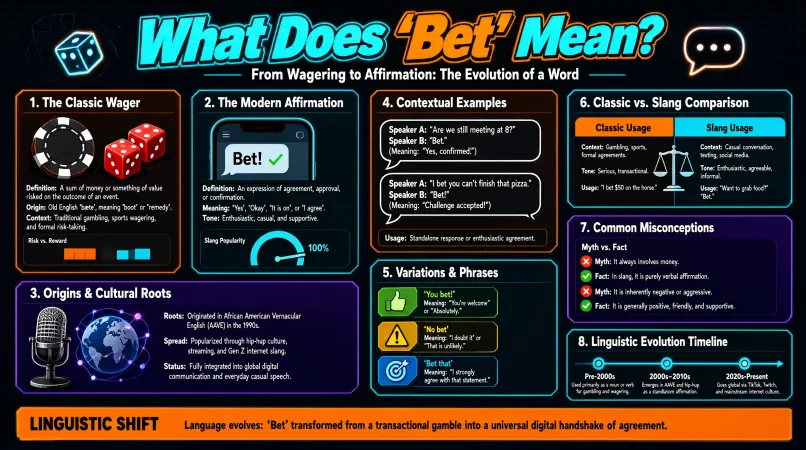
The meaning of bet depends on context.
In modern slang, bet usually means:
- Okay
- Sure
- Agreed
- Sounds good
- Deal
- I’m in
- Got it
- Absolutely
- Challenge accepted
For example:
Person A: “Meet me at 7?”
Person B: “Bet.”
Here, bet means “Sure” or “Sounds good.”
But the word can have other meanings in standard English. As a regular English word, bet can refer to a wager or an act of risking something on an uncertain result. Dictionary.com also lists phrases such as “you bet” and “best bet,” which have meanings that are different from the modern one-word slang reply.
So, when you see bet, always look at the context.
Bet Meaning in Text
The most common bet meaning in text is “okay,” “sure,” or “agreed.”
People often use it as a short reply instead of typing a full sentence.
Example 1: Confirming a plan
Friend: “I’ll meet you after school.”
You: “Bet.”
Meaning: “Okay, sounds good.”
Example 2: Accepting an invitation
Friend: “Want to get pizza later?”
You: “Bet.”
Meaning: “Sure, I’m in.”
Example 3: Confirming information
Friend: “I’ll send you the notes tonight.”
You: “Bet.”
Meaning: “Okay, got it.”
This is why bet meaning in text is usually connected with agreement and confirmation. It is short, casual, and easy to use.
What Does “Bet” Mean in Slang?

In slang, bet is commonly used as an informal way to show agreement or approval.
It can replace phrases such as:
- “Okay.”
- “Sure.”
- “Sounds good.”
- “I agree.”
- “I’m down.”
- “No problem.”
- “Absolutely.”
- “Deal.”
Dictionary.com describes this slang use as an affirmation, agreement, or approval and notes that the expression can also suggest doubt in certain contexts.
Example
Person A: “Let’s watch a movie tonight.”
Person B: “Bet.”
The natural meaning is:
“Sure, sounds good.”
The slang use is informal, so it works best in casual conversations rather than formal writing.
“Bet” Can Mean “Challenge Accepted”
Sometimes bet has a stronger meaning.
Instead of simply saying “okay,” a person may use bet to accept a challenge.
Example
Person A: “You probably can’t finish that task today.”
Person B: “Bet.”
Here, bet can mean:
“Watch me.”
“I’ll prove it.”
“Challenge accepted.”
The meaning comes from the situation and tone.
A short “Bet!” can sound confident or playful when someone makes a bold statement.
“Bet” Can Show Confidence
Another common use of bet is to show confidence.
Example
Friend: “I think our team is going to win.”
You: “Bet.”
Depending on the conversation, this could mean:
- “I agree.”
- “Absolutely.”
- “I believe you.”
- “For sure.”
The exact feeling is not always the same. Context matters.
This flexible use is one reason the word has become popular in casual digital communication.
Can “Bet” Be Sarcastic?
Yes. Bet can sometimes sound sarcastic.
This usually happens when someone does not fully believe what another person has said.
Example
Person A: “I’m going to become a millionaire next week.”
Person B: “Bet.”
Depending on the tone, Person B might genuinely agree, or they might mean:
“Yeah, sure.”
Dictionary.com specifically notes that slang bet can express doubt or disbelief in some situations.
The same word can therefore have different meanings:
“Bet.” = “Sounds good.”
“Bet…” = “Yeah, sure.”
“BET!” = “Challenge accepted!”
The surrounding conversation is the key.
How Do People Use “Bet” in Conversation?
The word is most natural in casual conversations.
Here are some common situations.
1. Making plans
Friend: “Meet me at 6?”
You: “Bet.”
Meaning: “Sure.”
2. Agreeing with someone
Friend: “That was a great movie.”
You: “Bet.”
Meaning: “I agree.”
3. Accepting an idea
Friend: “Let’s study together tomorrow.”
You: “Bet.”
Meaning: “Sounds good.”
4. Accepting a challenge
Friend: “I don’t think you can do it.”
You: “Bet.”
Meaning: “Challenge accepted.”
5. Showing confidence
Friend: “We’re going to do great.”
You: “Bet.”
Meaning: “Absolutely.”
What Does “Bet” Mean on Social Media?
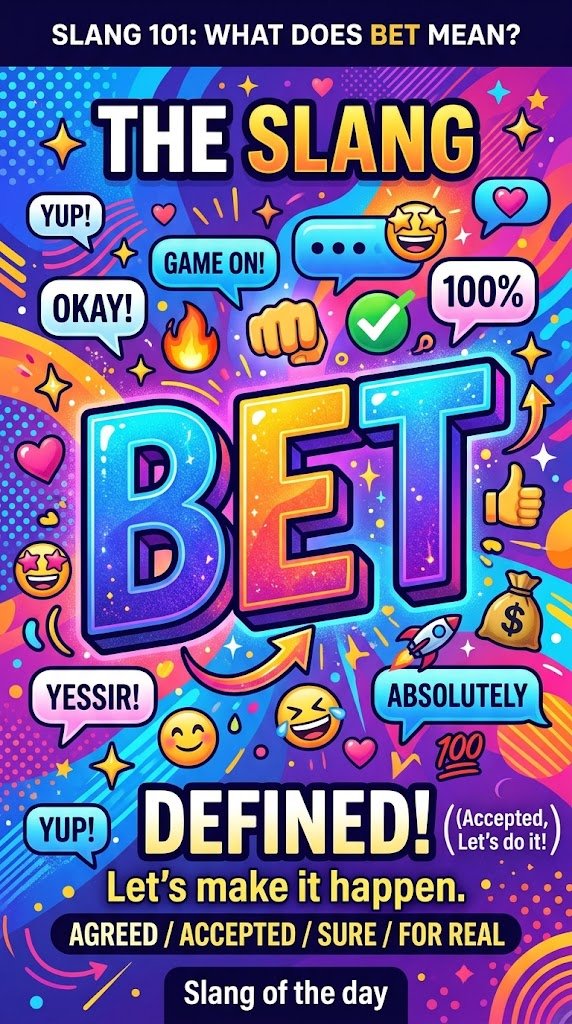
On social media, bet usually has the same casual meaning as it does in text messages.
You may see it in:
- Comments
- Direct messages
- Group chats
- Short replies
- Casual posts
- Gaming conversations
For example:
Comment: “I’ll post the second part tomorrow.”
Reply: “Bet.”
The reply can mean:
“Sounds good. I’ll be there.”
Social media favors short replies, so a single word can communicate a complete idea.
What Does “Bet” Mean on TikTok?
When people use bet on TikTok or similar social platforms, it often means “okay,” “I’m in,” “sure,” or “challenge accepted.”
For example:
Person: “You won’t try this.”
Reply: “Bet.”
The meaning can be:
“Watch me.”
In another conversation:
Person: “New video tonight?”
Reply: “Bet.”
That means:
“Yes, sounds good.”
The platform does not change the basic meaning. The conversation gives the word its exact tone.
What Does “Bet” Mean in a Text From a Friend?
If a friend sends you “bet” after you make a plan, they are usually agreeing.
For example:
You: “Want to hang out Saturday?”
Friend: “Bet.”
This normally means:
“Sure, I’m in.”
If your friend sends “bet” after you make a bold claim, the meaning may be different.
You: “I can finish this before dinner.”
Friend: “Bet.”
That could mean:
“Okay, prove it.”
So, don’t automatically assume every bet means exactly the same thing.
What Does “Bet” Mean From a Girl or Guy?
The word bet does not have a special meaning based only on whether the person is a girl or a guy.
Its meaning comes from the conversation.
For example:
Person: “I’ll see you tomorrow.”
Reply: “Bet.”
The reply usually means “Okay” or “Sounds good.”
Likewise:
Person: “You can’t beat me.”
Reply: “Bet.”
Here, it can mean “Challenge accepted.”
It is better to look at the message before and after bet rather than trying to give the word a special meaning based on the person who sent it.
Is “Bet” a Good or Bad Word?
Usually, bet is neither good nor bad.
It is a casual slang expression.
Its tone can be:
- Friendly
- Positive
- Confident
- Playful
- Competitive
- Sarcastic
The meaning depends on context.
For example:
“Want to come with us? Bet!”
This sounds positive and excited.
But:
“Sure, bet…”
could sound doubtful or sarcastic.
That difference comes from context and tone.
Is “Bet” an Acronym?
No. In the common slang use, bet is not an acronym.
It is the ordinary English word bet being used as an informal expression.
Dictionary.com connects the slang sense to the older expression “you bet,” which was already used as an affirmative expression meaning something like “indeed” or “of course.”
There is also a separate meaning of BET as the abbreviation for Black Entertainment Television. That is a different use of the letters and should not be confused with slang bet.
Where Did the Slang “Bet” Come From?
The modern slang use has a longer history than many people realize.
The ordinary English word bet is much older. Dictionary.com dates the word to the late 1500s.
The affirmative phrase “you bet” was used in American English by the 19th century. Dictionary.com explains that the modern slang use is connected to this older affirmative expression. It also says the slang form was recorded in the 1990s and was likely popularized through Black popular culture.
So, although bet is strongly associated with younger people and internet slang today, the basic idea of using it to express agreement is not new.
Why Do People Say “Bet” Instead of “Okay”?
One reason is speed.
In a text conversation, people often prefer short replies.
Compare:
“Okay, that sounds good. I’ll be there.”
with:
“Bet.”
The second response is much shorter.
It can still communicate agreement, confidence, or acceptance.
Another reason is tone. Bet can sound more casual and energetic than a simple “okay.”
For example:
“Okay.”
can sound neutral.
“Bet!”
can sound more confident or excited.
Of course, tone depends on the person and conversation.
Bet vs. Okay
Both words can show agreement, but they do not always feel the same.
| Word | Common meaning | Tone |
| Bet | Sure, agreed, deal | Casual |
| Okay | I understand / yes | Neutral |
| Sure | Yes | Friendly |
| Deal | We agree | Casual |
| Absolutely | Definitely | Strong |
| I’m in | I want to join | Casual |
| Got it | I understand | Casual |
Example
“Meet at 8?”
“Okay.”
Simple agreement.
“Bet.”
Casual agreement.
“Deal.”
Agreement to the plan.
“I’m in.”
Shows willingness to participate.
Bet vs. “You Bet”
The phrases bet and you bet are related, but they are not always used in exactly the same way.
Bet
“Want to go?”
“Bet.”
Meaning: “Sure.”
You bet
“Can you help me?”
“You bet.”
Meaning: “Of course.”
“You bet” is an established informal expression of strong agreement or assurance. Dictionary.com lists it with the meaning “of course” or “surely.”
Common Phrases With “Bet”
The word appears in several common expressions.
“I bet”
I bet can mean that you strongly believe something is true.
Example:
“I bet she knows the answer.”
Meaning:
“I think she probably knows the answer.”
This is different from the one-word slang reply.
“You bet”
You bet means “of course” or “certainly.”
Example:
“Can you help me?”
“You bet.”
“Best bet”
Best bet means the best choice or option.
Example:
“Your best bet is to leave early.”
Here, bet is part of a common expression rather than internet slang.
When Should You Use “Bet”?
Use bet when you are talking casually with people you know.
It can work well in:
- Text messages
- Group chats
- Casual conversations
- Social media
- Friendly messages
- Informal online communities
Example
Friend: “I’ll call you later.”
You: “Bet.”
That sounds natural in a casual conversation.
When Should You Avoid “Bet”?
Because bet is informal slang, it may not fit formal situations.
For example, you would usually choose more direct language in:
- School assignments
- Formal emails
- Job applications
- Professional reports
- Business documents
- Official letters
Instead of:
“Bet, I’ll send the file.”
a professional message could say:
“Sure, I’ll send the file.”
The meaning is similar, but the tone is more appropriate.
How to Reply When Someone Says “Bet”
There is no single correct response.
If someone says bet to confirm a plan, you can simply continue the conversation.
Example
You: “See you at 5.”
Friend: “Bet.”
You: “See you then.”
If someone says bet as a challenge, you can respond based on the situation.
Example
You: “I can finish this today.”
Friend: “Bet.”
You: “Just wait.”
The important thing is to understand the context.
Bet Meaning: Quick Examples
Here are several simple examples:
“Meet at 9?” — “Bet.”
Meaning: Sure.
“I’ll text you later.” — “Bet.”
Meaning: Okay.
“Let’s watch a movie.” — “Bet.”
Meaning: I’m in.
“You can’t do it.” — “Bet.”
Meaning: Challenge accepted.
“We’re going to win.” — “Bet.”
Meaning: Absolutely / I agree.
“He says he can do it in five minutes.” — “Bet.”
Meaning: Possibly “Yeah, sure,” depending on tone.
PAA: Common Questions About “Bet”
What does “bet” mean in texting?
In texting, bet usually means “okay,” “sure,” “agreed,” “sounds good,” or “deal.” It can also mean “challenge accepted” when someone responds to a challenge.
What does “bet” mean in slang?
In slang, bet is a casual expression of agreement, approval, confidence, or acceptance. Its exact meaning depends on the conversation.
What does “bet” mean from a friend?
When a friend says bet, they usually mean “okay,” “sure,” or “sounds good.” If the conversation involves a challenge, it can mean “challenge accepted.”
Is “bet” a Gen Z word?
Bet is strongly associated with modern youth slang, but the expression is older than Gen Z. Its modern slang use has roots in earlier American usage and Black popular culture.
Does “bet” mean yes?
Often, yes. In casual conversation, bet can work like “yes,” “sure,” or “I agree.” However, context can give it a sarcastic or challenging meaning.
Does “bet” mean okay?
Yes. “Okay” is one of the most common translations of slang bet.
What does “bet” mean on social media?
On social media, bet commonly means “okay,” “agreed,” “I’m in,” or “challenge accepted.” The meaning depends on the post or conversation.
Is “bet” rude?
Usually, no. It is normally a casual slang word. However, using it in a formal situation can sound too informal, and a sarcastic bet can sound dismissive.
Is “bet” an abbreviation?
No. The common slang bet is not an abbreviation. It is an informal use of the existing English word.
What does “you bet” mean?
“You bet” usually means “of course,” “certainly,” or “sure.” It is a common informal expression of agreement.
Article Summary
The bet meaning changes with context. In modern texting and slang, bet most often means “okay,” “sure,” “agreed,” “sounds good,” or “I’m in.” It can also show confidence or mean “challenge accepted.” In some conversations, it may sound sarcastic or doubtful.
The word also has older standard-English meanings and appears in phrases such as “I bet,” “you bet,” and “best bet.” The slang use is connected to the older affirmative phrase “you bet” and has been documented in American slang for decades.
The easiest way to understand bet is to look at the conversation around it. If someone uses it after a plan, it usually means agreement. If they use it after a challenge, it can mean confidence or acceptance of the challenge.
Conclusion
The simple answer to “What does bet mean?” is: it usually means “okay,” “sure,” “agreed,” or “deal” when used as modern slang.
For example, if someone says, “Meet me at 7?” and you reply “Bet,” you are saying that you agree with the plan. If someone says, “You can’t do it,” and you answer “Bet,” the meaning may be “challenge accepted.”
The word is common in casual texting, social media, and everyday American English. Just remember that tone and context matter. In formal writing, a clearer word such as “sure,” “agreed,” or “certainly” is usually a better choice.

Olivia Bennett is a dedicated content writer passionate about slang, word meanings, and digital communication. She creates simple and helpful content to make language easy for everyone to understand.