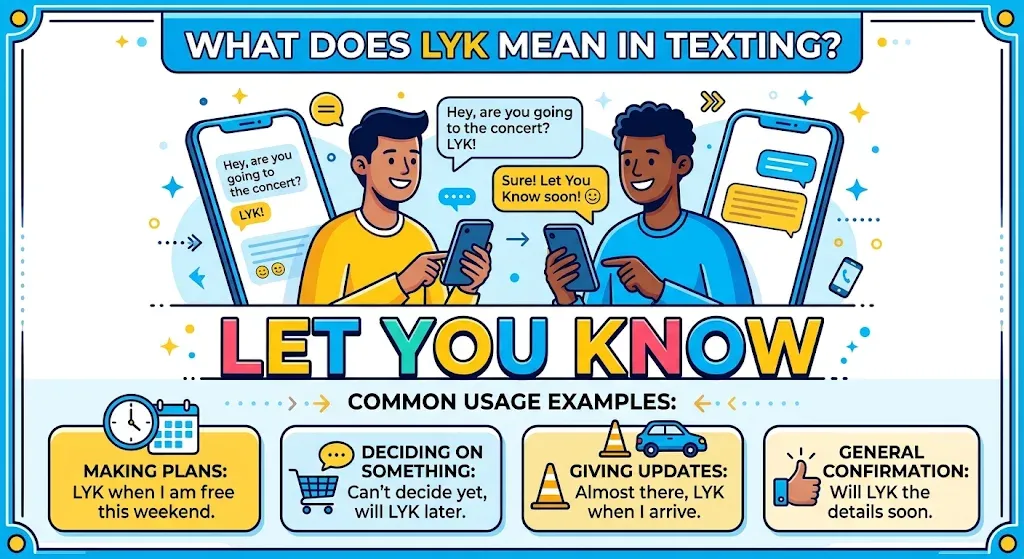
LYK stands for “let you know.” It is a short form people use in text messages and online chats.
People often use it when they do not have an answer yet but plan to share one later. It can also mean they will send an update when they have more information.
For example:
- “I’ll LYK tomorrow.” — I will let you know tomorrow.
- “Let me LYK when I’m free.” — Let me tell you when I am free.
- “I’ll LYK if I can come.” — I will tell you if I can come.
LYK is casual, so it works well in chats with friends, family, and people you know. In formal emails or work messages, it is usually better to write the full phrase, “let you know.”
What Does LYK Stand For?
LYK stands for “let you know.”
Here is a simple breakdown:
- L: Let
- Y: You
- K: Know
The letters represent the main words in the phrase. This makes LYK quick to type and easy to remember.
Is LYK a Word or an Abbreviation?
LYK is an abbreviation used in digital communication. It is not usually spoken as a word in everyday conversation.
Instead, people type it to shorten a message. When reading it, you can simply understand it as “let you know.”
For example, if someone says, “I’ll LYK later,” read it as “I’ll let you know later.”
How Is LYK Used in Text Messages?
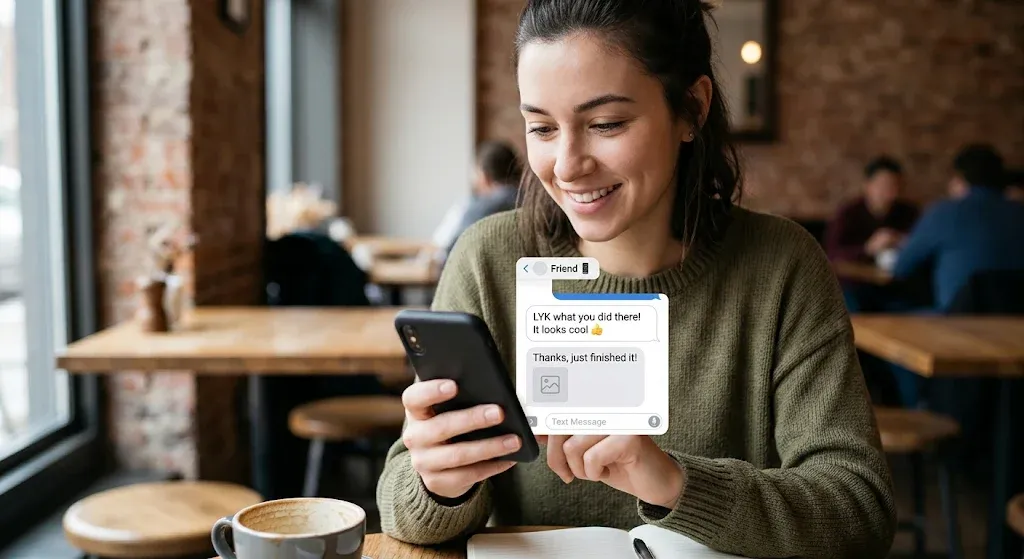
People use LYK in different ways, but the main idea stays the same: they will share information with someone.
1. When Someone Needs More Time
Sometimes, a person needs time to make a choice. They may use LYK to say they will give you an answer later.
Example:
You: “Do you want to go to the movies tonight?”
Friend: “Not sure yet. I’ll LYK.”
Meaning: Your friend has not decided and will tell you later.
2. When Sharing an Update
LYK can also mean that someone will send you news or information when it becomes available.
Example:
You: “Did the teacher change the test date?”
Friend: “I’ll LYK when I find out.”
Meaning: Your friend will share the answer after learning more.
3. When Making Plans
People often use LYK while talking about plans, meetings, trips, or events.
Example:
You: “Are you coming to my birthday party?”
Friend: “I’ll LYK by Friday.”
Meaning: Your friend will confirm by Friday.
4. When Talking About Time
Someone may use LYK if they are not sure when they will be free.
Example:
You: “Can we talk tonight?”
Friend: “I’ll LYK after dinner.”
Meaning: Your friend will tell you after dinner.
5. In Group Chats
LYK can also appear in group messages when people plan an event or share updates.
Example:
“Guys, I’ll LYK the final time once everyone replies.”
Meaning: The person will share the final time after hearing from everyone.
What Does LYK Mean From a Girl?
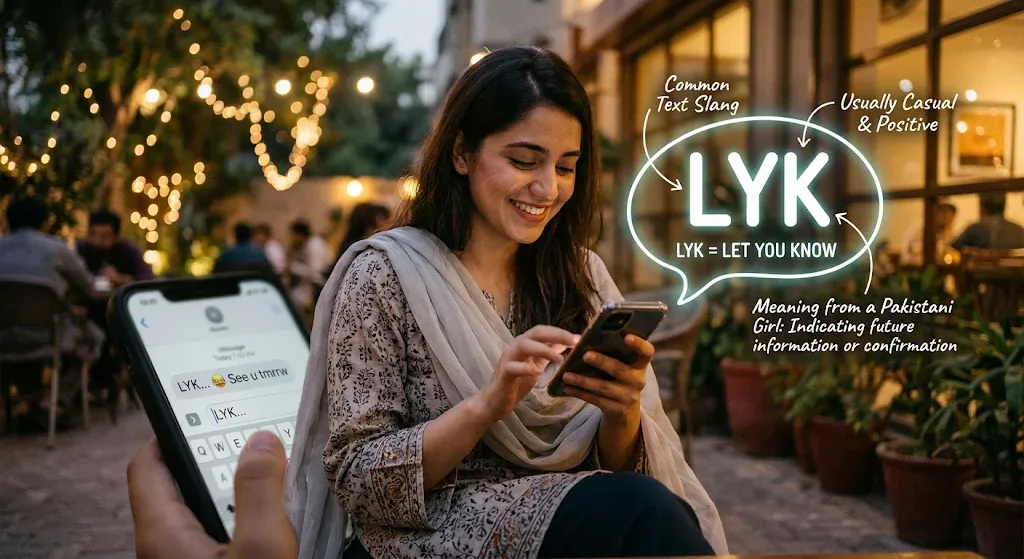
If a girl texts you LYK, it usually means “let you know.” The exact meaning depends on what you were talking about.
For example:
- “I’ll LYK if I’m free.” — She will tell you whether she is available.
- “I’ll LYK later.” — She plans to give you an update later.
- “Let me check, then I’ll LYK.” — She needs to check something first.
LYK does not automatically mean that she likes you romantically. It is a common texting abbreviation that can be used with friends, classmates, family, or someone she is getting to know.
Pay attention to the full conversation rather than trying to find a hidden meaning in one short message.
What Does LYK Mean From a Guy?
When a guy sends LYK, it also usually means “let you know.”
He may use it when making plans, answering a question, or waiting for more information.
For example:
You: “Are we playing cricket tomorrow?”
Him: “I’ll LYK in the morning.”
This means he will tell you in the morning whether he can play.
The abbreviation does not prove that he is interested in you or that he is avoiding you. His message may simply mean that he has not made a decision yet.
If you need a clear answer, you can ask politely when he expects to know.
What Does LYK Mean on Snapchat, Instagram, and Other Apps?
What Does LYK Mean on Snapchat, Instagram, and Other Apps?
LYK usually has the same meaning across messaging apps: “let you know.” The app does not normally change its meaning, but the sentence around it can help you understand the message.
LYK on Snapchat
On Snapchat, someone might use LYK when talking about plans or waiting for an answer.
Example:
“lyk when ur done”
Meaning: Let me know when you are done.
Another example:
“I’ll lyk if I can come.”
Meaning: I will tell you whether I can come.
LYK on Instagram
On Instagram, LYK may appear in direct messages (DMs) between friends or followers.
Example:
“I’ll lyk when I post the pics.”
Meaning: I will tell you when I post the pictures.
It can also appear in casual conversations about events, photos, or plans.
LYK on WhatsApp
On WhatsApp, people may use LYK in private chats or group conversations.
Example:
“Waiting for my brother. I’ll lyk when he arrives.”
Meaning: I will update you when my brother arrives.
LYK on TikTok
On TikTok, you may see short forms like LYK in comments or private messages. The exact meaning depends on how the letters are used.
For example, “I’ll lyk later” usually means “I’ll let you know later.”
However, lowercase “lyk” can sometimes be used as a casual spelling of “like.” This use is less standard, so read the full sentence before deciding what the sender means.
What Does “I’ll LYK” Mean?
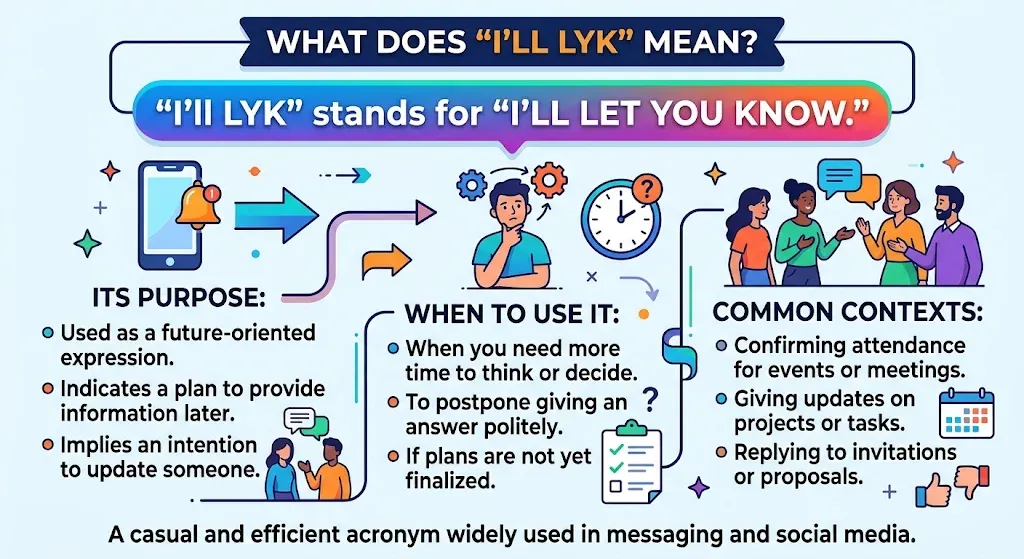
“I’ll LYK” means “I’ll let you know.”
It tells you that someone plans to share information, give an answer, or confirm something later.
Here are a few examples:
| Text message | Simple meaning |
| “I’ll lyk tomorrow.” | I will tell you tomorrow. |
| “I’ll lyk when I arrive.” | I will update you when I arrive. |
| “I’ll lyk after class.” | I will tell you after class. |
| “I’ll lyk if anything changes.” | I will tell you if there is a change. |
| “I’ll lyk once I know.” | I will tell you when I have the answer. |
The phrase does not tell you what the final answer will be. It only says that the person plans to update you.
For example, “I’ll LYK if I can come” does not mean the person has agreed to come. They still need to decide.
How Do You Reply When Someone Says LYK?
Your reply can be short and friendly. You do not need to use more slang just because the other person did.
Simple Replies to LYK
Here are some natural responses:
- “Okay, thanks!”
- “Sounds good.”
- “Sure, let me know.”
- “No problem.”
- “Alright, I’ll wait.”
- “Cool, keep me posted.”
- “Thanks for the update.”
Choose a reply that fits the conversation.
Example 1: Making Plans
Friend: “I’ll lyk if I can come tonight.”
You: “Okay, just let me know.”
Your reply shows that you understand and are willing to wait.
Example 2: Waiting for Information
Friend: “I’ll lyk when I hear back.”
You: “Sounds good. Thanks!”
This is a polite way to respond.
Example 3: Talking About School
Classmate: “I’ll lyk when the teacher shares the homework.”
You: “Okay, thanks for helping!”
This reply works well in a school conversation.
Example 4: When You Need an Answer Soon
Friend: “I’ll lyk later.”
You: “Sure. Could you let me know by 5 PM?”
This gives the person a clear time without sounding rude.
What Is the Difference Between LYK and LMK?
LYK and LMK look similar, but they usually mean different things.
- LYK: Let you know.
- LMK: Let me know.
The easiest way to remember the difference is to look at who is expected to share the information.
| Abbreviation | Full form | Main purpose |
| LYK | Let you know | The sender plans to give you information. |
| LMK | Let me know | The sender asks you to give them information. |
| ILYK | I’ll let you know | The sender promises to update you. |
| FYI | For your information | The sender shares information with you. |
| JSYK | Just so you know | The sender gives you a quick note or reminder. |
LYK Example
“I’ll LYK when I get home.”
The sender will update you later.
LMK Example
“LMK when you get home.”
The sender wants you to send an update.
FYI Example
“FYI, the meeting starts at 3 PM.”
The sender is sharing information now, not promising an update later.
These abbreviations may all appear in the same chat, but they serve different purposes.
Does LYK Have Other Meanings?
Yes, the letters can have other meanings in certain situations, but “let you know” is the main meaning in ordinary texting.
In some casual online writing, people use “lyk” as a shortened spelling of “like.”
For example:
“I lyk your new shoes.”
In this sentence, the person likely means “I like your new shoes.”
Compare that with:
“I’ll lyk about the shoes.”
Here, LYK means “let you know.”
The sentence structure helps you tell the difference.
How to Tell Which Meaning Is Correct
Use these simple clues:
- If you see “I’ll LYK,” it usually means “I’ll let you know.”
- If the message is about a future update, LYK likely means “let you know.”
- If “lyk” appears where the verb “like” would normally go, it may mean “like.”
- If the sentence still seems unclear, ask the sender what they mean.
Do not assume an unusual meaning when the common one fits the conversation.
Is LYK Formal or Informal?
LYK is informal texting slang. It works best in relaxed conversations where both people understand common abbreviations.
When LYK Is Fine to Use
You can use LYK in:
- Text messages with friends
- Casual family chats
- Group messages
- Social media DMs
- Informal conversations with classmates
For example:
“I’ll lyk after school.”
This is short and easy to understand in a casual chat.
When You Should Avoid LYK
In formal emails, school applications, official letters, or professional messages, writing the full phrase is usually better.
Instead of:
“I’ll LYK when I finish the report.”
Write:
“I’ll let you know when I finish the report.”
The full phrase looks clearer and more professional. It also helps readers who may not know texting slang.
Why Do People Use LYK Instead of the Full Phrase?
People often use abbreviations because they make messages shorter and quicker to type.
LYK can be useful when someone wants to respond quickly but does not have all the details yet.
For example, a friend may ask whether you can attend an event. You might need to check your schedule first.
Instead of writing a long message, you can say:
“I need to check my schedule. I’ll lyk tonight.”
This gives the other person a quick response while making it clear that you will follow up.
However, short messages can sometimes leave out useful details. If you know when you will have an answer, adding a time can make your message clearer.
For example:
“I’ll lyk by 6 PM.”
This is more helpful than simply saying, “I’ll lyk later,” because the other person knows when to expect an update.
Common Mistakes to Avoid When Using LYK
LYK is simple, but a few common mistakes can cause confusion.
1. Confusing LYK With LMK
Remember that LYK means “let you know,” while LMK means “let me know.”
“I’ll LYK tomorrow” means you will share information tomorrow.
“LMK tomorrow” means you want the other person to share information tomorrow.
2. Assuming It Means Yes
If someone says, “I’ll lyk if I can come,” they have not confirmed their plans.
They are saying they will give you an answer later.
3. Assuming It Means No
LYK does not automatically mean rejection. The person may need more time, information, or help before deciding.
Wait for the person’s actual answer instead of guessing.
4. Using It in Every Message
Although LYK is useful, you do not need to shorten every phrase.
Clear communication is more important than using slang. If a full sentence makes your meaning easier to understand, use it.
5. Forgetting the Context
LYK usually means “let you know,” but lowercase “lyk” can sometimes mean “like.”
Read the whole sentence to understand the intended meaning.
People Also Ask About LYK Meaning in Texting
What Does LYK Mean in a Text From Someone You Like?
LYK usually means “let you know,” even when it comes from someone you like. It does not automatically show romantic interest. The person may simply be telling you that they will share an answer later.
Is LYK the Same as Let Me Know?
No. LYK usually means “let you know,” while LMK means “let me know.” LYK often promises an update, whereas LMK asks someone else to provide information.
What Does “I’ll LYK Later” Mean?
It means “I’ll let you know later.” The sender plans to give you an answer or update at another time.
Is LYK Rude?
No, LYK is not rude by itself. It is a casual abbreviation. However, the full message and the way someone communicates can affect how it feels.
Can I Use LYK in a Work Message?
You can use it in an informal work chat if the other person understands the abbreviation. For formal emails or messages to customers, “I’ll let you know” is a clearer choice.
Does LYK Mean Like You Know?
Not usually. In most texting conversations, LYK means “let you know.” The phrase “like, you know” may appear in speech or casual writing, but it is not the main meaning of LYK.
Article Summary
Here are the main points to remember about LYK:
- Full form: Let you know.
- Main meaning: To give someone information or an update later.
- Common example: “I’ll lyk tomorrow.”
- Tone: Usually casual and neutral.
- Similar abbreviation: LMK, meaning “let me know.”
- Other possible use: Lowercase “lyk” may sometimes be a shortened spelling of “like.”
- Best use: Casual texts, social media messages, and friendly chats.
- Formal alternative: Write “I’ll let you know” instead.
Conclusion
The LYK meaning in texting is simple: it usually stands for “let you know.” People use it when they plan to share an answer, confirm a plan, or give someone an update later.
For example, “I’ll LYK when I get home” means “I’ll let you know when I get home.” You may see it in text messages, Snapchat chats, Instagram DMs, and other casual conversations.
Remember that LYK is different from LMK. LYK usually means the sender will provide information, while LMK asks the other person to provide it. Also, lowercase “lyk” can sometimes mean “like,” depending on the sentence.
Now that you know what LYK means, you can understand it more easily and reply with confidence. When in doubt, read the full message and use the context to work out what the sender intends.
Read More Post
What Does EVB Mean in Text? Meaning, Uses & Examples
What Does HGS Mean in Text? Meaning, Uses, and Examples

Sophia Mitchell is a passionate writer and content researcher who enjoys exploring modern slang, texting abbreviations, internet phrases, and everyday expressions. She specializes in explaining word meanings in simple, clear, and easy-to-understand language. Through her articles, Sophia helps readers understand how words and phrases are used in daily conversations, social media, and online communication. Her goal is to make language learning simple, useful, and enjoyable for everyone.