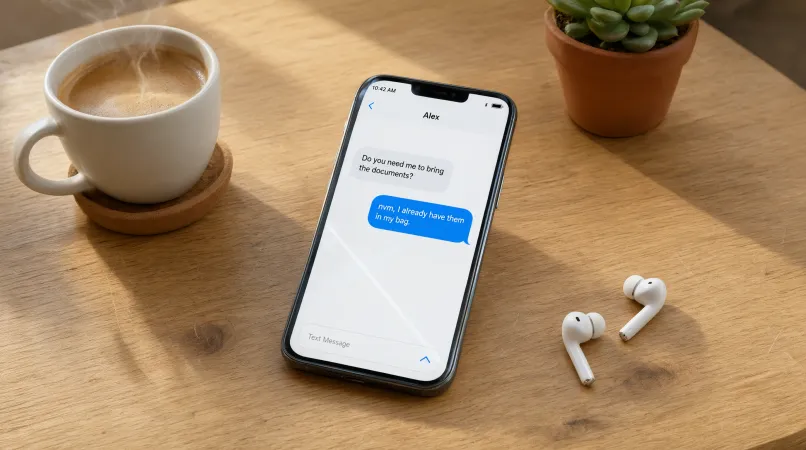
NVM stands for “never mind.” It is a common texting abbreviation used in messages, online chats, and social media conversations.
People use NVM when they want someone to ignore an earlier question, forget a request, or stop worrying about something. It can also mean that they have found an answer or no longer need help.
Simple Examples of NVM
Here are a few examples of how people use NVM in everyday chats:
- “NVM, I found my keys!”
- “Can you call me? NVM, I will call you.”
- “NVM about that question.”
- “NVM, I figured it out.”
- “NVM, it is not important anymore.”
In each example, NVM means that the earlier question, request, or problem no longer needs attention.
What Does Never Mind Mean?
The phrase “never mind” can have several meanings depending on the situation:
- Forget it: You no longer want someone to do something.
- It is okay: You do not need help anymore.
- I figured it out: You found the answer yourself.
- It does not matter: The topic is no longer important.
The surrounding words help you understand which meaning fits the conversation.
How Is NVM Used in Text Messages?
NVM is most often used in casual conversations. It is short, simple, and easy to understand when both people know the abbreviation.
1. When You No Longer Need Help
You may ask someone for help and then solve the problem on your own.
Example:
Person A: “Do you know how to fix this app?”
Person B: “What seems to be wrong?”
Person A: “NVM, I fixed it!”
Here, NVM means the person no longer needs help.
2. When You Change Your Mind
Sometimes, you ask for something and then decide you do not want it.
Example:
You: “Can you send me that picture?”
Friend: “Sure, give me a minute.”
You: “NVM, I already have it.”
In this case, NVM means the request is no longer needed.
3. When You Want Someone to Forget a Question
You might send a question and then realize that you do not need an answer.
Example:
You: “What time does the store close?”
Friend: “I think it closes at 9.”
You: “NVM, I just checked online.”
The abbreviation lets your friend know that you have found the information yourself.
4. When You Want to Drop a Topic
NVM can also help end a conversation about something that is no longer important.
Example:
Friend: “What did you want to tell me?”
You: “NVM, I will tell you later.”
This may mean you changed your mind or would rather discuss it another time. Depending on your tone, it could also make the other person curious or unsure.
5. When You Make a Mistake
5. When You Make a Mistake
You can also use NVM when you send the wrong message or notice that your question was unnecessary.
Example:
You: “Are you free on Friday?”
Friend: “Yes, why?”
You: “NVM, I meant Saturday.”
Here, NVM helps you move past the first question. You can also explain the mistake directly to avoid confusion.
What Does NVM Mean on Social Media?
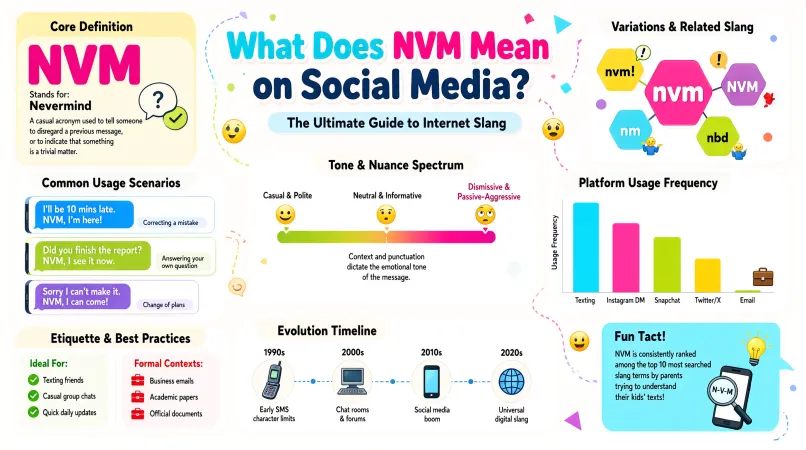
The meaning of NVM usually stays the same across social media platforms. It stands for “never mind,” whether you see it in a private message, comment, or group chat.
NVM on WhatsApp
On WhatsApp, people use NVM to cancel a request or explain that they no longer need help.
Example:
“Can you share the homework? NVM, my classmate sent it.”
The sender has already received the homework, so the request is no longer needed.
NVM on Instagram
On Instagram, NVM may appear in direct messages or comments. People often use it when they change their minds or decide not to ask something.
Example:
“Which picture did you mean? NVM, I found it.”
The person found the picture without needing more help.
NVM on Snapchat
On Snapchat, NVM can be used in quick, casual chats between friends.
Example:
“Wait, I have a question. NVM lol.”
This means the sender decided not to ask the question. The word “lol” may make the message feel more relaxed, but the exact tone depends on the conversation.
NVM on TikTok
On TikTok, you may see NVM in comments, captions, or private messages.
Example:
“What’s the name of that song? NVM, someone posted it below.”
The user found the song name and no longer needs an answer.
NVM in Gaming Chats
Players may use NVM during online games when a request becomes unnecessary.
Example:
“Can someone help me join the team? NVM, I’m in.”
The player joined the team without further help.
Across these platforms, the basic meaning remains “never mind.” The situation tells you why the person used it.
What Does NVM Mean From a Girl or a Guy?
If a girl or a guy texts you NVM, it usually means “never mind.” The abbreviation itself does not reveal a person’s feelings, intentions, or level of interest.
The meaning depends on the conversation.
Example 1: A Normal Conversation
Person A: “Can you tell me the answer?”
Person B: “Which answer?”
Person A: “NVM, I found it.”
This is a simple, everyday use. There is no clear sign of anger or any other special feeling.
Example 2: An Unfinished Question
Person A: “I wanted to ask you something…”
Person B: “What is it?”
Person A: “NVM, it’s okay.”
The sender may have changed their mind or decided not to discuss the topic. You cannot know the reason from NVM alone.
Example 3: A Possible Sign of Frustration
Person A: “Can you help me with this?”
Person B: “I’m busy right now.”
Person A: “NVM.”
In this case, the sender might be disappointed, or they may simply have decided to handle the task alone. More context is needed to understand their feelings.
Remember: Do not assume someone is upset, flirting, or losing interest just because they send NVM. Look at the full conversation instead of focusing on one abbreviation.
Is NVM Rude or Disrespectful?
NVM is not automatically rude. In many conversations, it is a normal and useful way to say that something no longer matters.
However, it can sound abrupt when someone sends it without explaining what happened.
When NVM Sounds Friendly
“NVM, I figured it out. Thanks anyway!”
This message sounds polite because the sender explains the situation and shows appreciation.
When NVM Sounds Neutral
“NVM, I found the answer.”
This is a simple message that gives the other person useful information.
When NVM May Sound Rude
“NVM. Forget it.”
Depending on the conversation, this may sound annoyed or dismissive. The person might be frustrated, but the message alone does not prove that.
How to Avoid Misunderstandings
If you are sending NVM, add a few words to explain what you mean.
Instead of:
“NVM.”
Try:
“NVM, I found it. Thanks!”
Instead of:
“NVM, forget it.”
Try:
“It’s okay, I figured it out.”
These small changes can make your message clearer and friendlier.
How to Reply When Someone Texts NVM
Your reply depends on what happened before the person sent NVM. Sometimes, you do not need to reply at all. In other cases, a short and friendly message can help.
Here are some natural responses.
1. If They Found the Answer
Their message: “NVM, I got it.”
Your reply:
- “Okay, great!”
- “Glad you figured it out.”
- “No problem!”
These responses fit a normal conversation.
2. If They No Longer Need Help
Their message: “NVM, I don’t need help anymore.”
Your reply:
- “All good!”
- “Okay, just let me know if you need anything.”
- “No worries.”
These replies show that you understand.
3. If They Seem Upset
Their message: “NVM.”
If the conversation feels tense, you can ask a calm question.
Your reply:
- “Okay, is everything alright?”
- “No problem. Let me know if you want to talk.”
- “Did I misunderstand something?”
Use these replies only when the situation gives you a reason to check in. A short NVM message does not always mean something is wrong.
4. If You Do Not Know What They Mean
You can ask them to explain.
Your reply:
“Do you mean I should ignore your last message?”
This is useful when their message is unclear.
5. If You Want to Keep the Conversation Going
You can respond naturally without making the situation awkward.
Their message: “NVM, I found it.”
Your reply: “Nice! Glad you found it.”
The best response is usually short, polite, and suited to the conversation.
NVM vs. NM: What Is the Difference?
NVM and NM look similar, but their meanings can differ.
| Abbreviation | Common meaning | Example |
| NVM | Never mind | “NVM, I found it.” |
| NM | Not much | “NM, just relaxing.” |
| NM | Never mind, in some contexts | “NM, I fixed it.” |
NM can have more than one meaning. For example, if someone asks, “What’s up?” and you reply “NM,” you probably mean “not much.”
NVM is usually clearer when you want someone to ignore an earlier message or request.
Tip: If you want to avoid confusion, use NVM for “never mind” and write “not much” in full when needed.
NVM vs. Similar Texting Abbreviations
Other texting expressions may seem similar to NVM, but each has a slightly different use.
NVM vs. IDC
- NVM: Never mind; something no longer needs attention.
- IDC: I don’t care; the speaker says something does not matter to them.
Example of NVM: “NVM, I found another way.”
Example of IDC: “IDC which movie we watch.”
IDC can sound dismissive depending on the situation, while NVM often refers to a previous question or request.
NVM vs. DW
- NVM: Never mind.
- DW: Don’t worry.
Example of NVM: “NVM, I solved the problem.”
Example of DW: “DW, I’ll help you tomorrow.”
NVM says that something can be dropped. DW reassures someone that they do not need to worry.
NVM vs. NP
- NVM: Never mind.
- NP: No problem.
Example of NVM: “NVM, I already have the notes.”
Example of NP: “Thanks for sending the notes!” “NP!”
NVM often cancels a request, while NP is commonly used to respond to thanks or show that something is not a problem.
NVM vs. LOL
- NVM: Never mind.
- LOL: Laughing out loud, often used to show amusement or soften a casual message.
Example of NVM: “NVM, I read the wrong date.”
Example of LOL: “I forgot my own password lol.”
These abbreviations serve different purposes, even though they can appear in the same message.
Can You Use NVM in Formal Messages?
NVM is best for informal communication. It works well in casual texts with friends, classmates, and people who understand texting slang.
However, it may not be suitable for a formal email, school assignment, job application, or professional message.
Informal Example
“NVM, I found the file.”
This is fine in a casual chat.
Formal Example
“Please disregard my previous message. I have found the file.”
This version is clearer and more professional.
You can also write:
- “Never mind, I have resolved the issue.”
- “Please ignore my earlier question.”
- “I no longer need assistance. Thank you.”
Choose the wording that fits your audience. When you are unsure whether the other person knows the abbreviation, writing the full phrase is a safe choice.
Does Capitalization Change the Meaning of NVM?
No. In ordinary texting, NVM, nvm, and Nvm usually mean the same thing: “never mind.”
Examples:
- “NVM, I got it.”
- “nvm, I got it.”
- “Nvm, I got it.”
All three communicate the same basic idea.
Capital letters may make a message look more forceful to some readers, but they do not create a different standard meaning. The full sentence and conversation matter more than capitalization alone.
Can NVM Have Other Meanings?
Yes. Although “never mind” is the usual meaning in texting, NVM can stand for other terms in technical settings.
For example, in computing, NVM may refer to non-volatile memory. This is a type of memory that can keep stored information even when the power is turned off.
The intended meaning depends on the subject.
- In a casual text: “NVM, I found it” means “never mind.”
- In a computer discussion: “NVM” may refer to non-volatile memory.
If you see NVM in a technical document, do not assume it has the same meaning as it does in a text message.
Common Mistakes to Avoid When Using NVM
NVM is easy to understand, but a few mistakes can lead to confusion.
1. Assuming It Always Means Someone Is Angry
A person may send NVM because they found an answer or changed their mind. Do not assume they are upset without more context.
2. Using It in Formal Writing
NVM is an informal abbreviation. In professional messages, write “never mind” or explain what you mean.
3. Sending Only NVM When More Detail Is Needed
A single NVM can leave the other person wondering what happened. If possible, add a short explanation.
For example, “NVM, I found the address” is clearer than “NVM.”
4. Confusing NVM With NM
NM can mean “not much” or, in some situations, “never mind.” NVM is generally the clearer choice when you want someone to disregard an earlier message.
5. Forgetting About Context
The same abbreviation can feel friendly, neutral, or abrupt in different conversations. Read the surrounding messages before deciding what someone means.
People Also Ask About NVM
What does NVM mean in text from a friend?
It usually means “never mind.” Your friend may have found an answer, changed their mind, or decided that they no longer need help.
What does NVM mean in a chat?
In a chat, NVM is a short form of “never mind.” It tells the other person that an earlier question, request, or topic can usually be ignored.
Is NVM the same as forget it?
They are similar, but their tone can differ. NVM often means that something is no longer needed. “Forget it” can sometimes sound more annoyed or forceful.
Is NVM slang?
Yes. NVM is a common informal abbreviation used in texting, online chats, and social media.
Should I reply when someone says NVM?
You do not always need to reply. If the meaning is clear, you can say “Okay,” “No problem,” or “Glad you figured it out.” If the message is confusing, ask what they mean.
Does NVM mean never mind in every situation?
No. “Never mind” is the usual meaning in casual texting, but NVM can have different meanings in technical fields. The context helps you identify the right definition.
Article Summary
- NVM meaning in text: Never mind.
- Full form: Never mind.
- Main purpose: To cancel a request, drop a topic, or say that something is no longer important.
- Common uses: Text messages, social media, online chats, and gaming conversations.
- Tone: Usually casual, but it can sometimes sound abrupt.
- Similar abbreviations: NM, IDC, DW, and NP.
- Formal alternative: “Please disregard my previous message.”
- Technical meaning: NVM can refer to non-volatile memory in computing.
Conclusion
The NVM meaning in text is simple: NVM stands for “never mind.” People use it when they no longer need help, have found an answer, change their minds, or want to move on from a topic.
You may see NVM in text messages, WhatsApp chats, Instagram DMs, Snapchat messages, TikTok comments, and gaming conversations. In most cases, it is a normal part of casual online communication.
Remember that NVM does not automatically mean someone is angry or upset. The tone depends on the words around it and the situation. When you use it, adding a few extra words can make your message clearer and friendlier.
Now that you know what NVM means, you can understand it more easily and use it naturally in everyday chats.

Sophia Mitchell is a passionate writer and content researcher who enjoys exploring modern slang, texting abbreviations, internet phrases, and everyday expressions. She specializes in explaining word meanings in simple, clear, and easy-to-understand language. Through her articles, Sophia helps readers understand how words and phrases are used in daily conversations, social media, and online communication. Her goal is to make language learning simple, useful, and enjoyable for everyone.