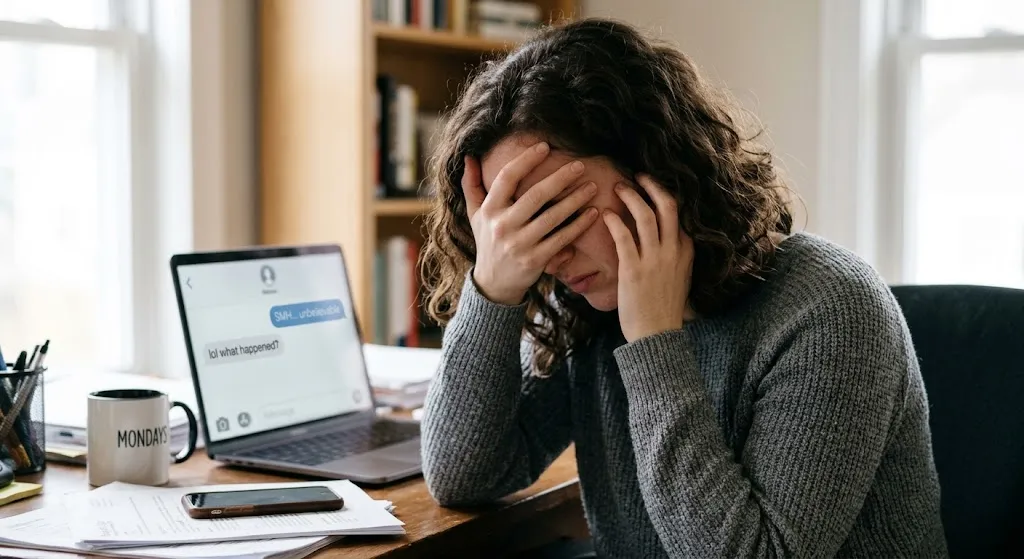
SMH means “shaking my head.”
It is an internet abbreviation used in texts and online conversations to show a reaction such as:
- Disbelief
- Disappointment
- Annoyance
- Frustration
- Disapproval
- Mild embarrassment
- Amused disbelief
Cambridge Dictionary defines SMH as an abbreviation for “shaking my head” and notes that it is used in texts and on social media when someone does not believe or approve of something.
For example:
Friend: “I forgot my homework at home again.”
You: “SMH.”
Here, SMH means something like, “I can’t believe you did that again.”
The meaning is usually clear from the message around it.
What Does SMH Stand For?
SMH stands for:
S = Shaking
M = My
H = Head
So, the full phrase is “shaking my head.”
The phrase comes from the real-life action of shaking your head when something seems silly, disappointing, confusing, or hard to believe.
When people cannot show body language in a text conversation, SMH works as a quick written reaction.
What Does SMH Mean in a Text Message?
In a text message, SMH usually tells the other person that you are reacting negatively or with disbelief to something they said or did.
For example:
“You forgot your keys again? SMH.”
This does not necessarily mean the sender is very angry. It may simply mean:
- “Seriously?”
- “I can’t believe it.”
- “Come on.”
- “That was silly.”
- “I expected better.”
The relationship between the people matters. A close friend may use SMH in a playful way, while the same message from someone you do not know well may sound more critical.
Examples of SMH in Text
Here are some simple examples.
Example 1: A Small Mistake
Alex: “I left my phone in the car.”
Sam: “SMH 😂”
The sender is probably teasing Alex rather than showing serious anger.
Example 2: Disappointment
Alex: “Our game was canceled again.”
Sam: “SMH. That’s so disappointing.”
Here, SMH shows frustration about the situation.
Example 3: Forgetting Something
Alex: “I forgot to bring my project.”
Sam: “SMH, you worked on it all night!”
The sender is expressing disbelief.
Example 4: A Funny Mistake
Alex: “I put my cereal in the fridge.”
Sam: “SMH 😂”
This use is usually humorous.
Example 5: Reacting to Yourself
SMH does not have to be directed at another person.
“I studied the wrong chapter for two hours. SMH.”
Here, the person is joking about their own mistake.
Is SMH Rude?
SMH is not automatically rude.
Its tone depends on the context, the relationship between the people, and what happened before the message.
For example:
“You forgot your umbrella again? SMH 😂”
This may be friendly teasing.
But:
“You did that again. SMH.”
This could sound more serious or judgmental.
If someone sends only “SMH” without any other words, it can sometimes feel cold or dismissive because there is little information about their tone.
When you are unsure, look at the rest of the conversation. Emojis, punctuation, and the relationship between the people can help you understand the intended feeling.
Does SMH Mean Angry?
Not always.
SMH can show anger, but anger is only one possible meaning. It often shows a lighter reaction such as disbelief, disappointment, or mild frustration.
Compare these examples:
“SMH, I can’t believe you forgot again.”
This sounds frustrated.
“SMH 😂 You really wore two different shoes.”
This sounds playful.
“SMH. That was a terrible decision.”
This sounds more serious.
So, it is better to think of SMH as a reaction rather than a direct way of saying “I am angry.”
How Is SMH Used on Social Media?
SMH is common in casual online communication, including posts, comments, and messages. Dictionary sources list it as an abbreviation used in messaging and social media.
Someone may comment:
“SMH, people really believe this?”
The person is showing disbelief.
Another example is:
“SMH at this whole situation.”
Here, the person is expressing disappointment or frustration.
The abbreviation can also be written as smh in lowercase. Uppercase and lowercase normally have the same basic meaning.
SMH Meaning on Different Platforms
The basic meaning of SMH stays the same across most casual online spaces.
SMH in Texting
In texting, SMH is often a quick response to a friend’s mistake, surprising message, or frustrating situation.
“You missed the bus again? SMH.”
SMH on Instagram
On Instagram, someone may use SMH in a comment or message when reacting to a surprising or disappointing post.
“SMH, why would you do that?”
SMH on TikTok
On TikTok, SMH may appear in comments when someone reacts to a funny, strange, or frustrating video.
“SMH 😂 I can’t believe this happened.”
SMH in Group Chats
In a group chat, one person may type SMH after another person says something unexpected.
“You guys started without me? SMH.”
The exact tone still depends on the conversation.
What Does SMH Mean From a Girl?
If a girl texts you “SMH,” the basic meaning is still “shaking my head.”
It does not have one special meaning based on gender.
For example:
You: “I forgot the tickets.”
Her: “SMH 😂”
She may be teasing you.
But if she says:
“SMH. You really did that?”
She may be showing disappointment or disbelief.
Do not try to read too much into the abbreviation alone. Look at the full conversation and the situation.
What Does SMH Mean From a Guy?
If a guy sends “SMH,” it also normally means “shaking my head.”
It can be:
- A joke
- Friendly teasing
- Disbelief
- Frustration
- Disappointment
- Disapproval
For example:
“Bro, you forgot your wallet? SMH.”
This could simply be friendly teasing.
Can SMH Be Used as a Joke?
Yes.
SMH is often used in a playful or humorous way.
For example:
“I opened the fridge and forgot why I was there. SMH 😂”
The person is joking about their own behavior.
Another example:
“I spent 20 minutes looking for my glasses. They were on my head. SMH.”
In this case, the person is not seriously upset. They are laughing at their own mistake.
Can You Use SMH About Yourself?
Yes.
This is a common casual use.
You might say:
“I forgot to save my work. SMH.”
This means something like:
“I can’t believe I did that.”
Using SMH about yourself can make a mistake sound lighthearted rather than overly serious.
SMH vs. SMDH
SMH and SMDH are closely related.
SMH = “shaking my head”
SMDH = commonly understood as “shaking my damn head”
SMDH is a stronger version and can sound more intense or frustrated. SMH is the simpler and more common form.
If you want a mild reaction, SMH is usually enough.
SMH vs. LOL
These abbreviations communicate different reactions.
SMH usually expresses disbelief, disappointment, frustration, or disapproval.
LOL usually signals laughter or amusement.
For example:
“You forgot your own birthday? SMH.”
This shows disbelief.
“That joke was hilarious LOL.”
This shows amusement.
Sometimes people combine them:
“SMH LOL.”
That can mean the person finds a situation ridiculous and funny at the same time.
SMH vs. OMG
OMG means “oh my God” and usually expresses surprise, excitement, shock, or strong emotion.
SMH means “shaking my head” and usually expresses disbelief, disappointment, or frustration.
For example:
“OMG! We won!”
This shows excitement.
“SMH, we forgot to submit the form.”
This shows frustration or disbelief.
What Is the Difference Between SMH and SMDH?
The main difference is intensity.
SMH is the standard form:
SMH = shaking my head
SMDH is often used as a stronger version:
SMDH = shaking my damn head
SMDH can sound more frustrated or emphatic. Because it contains stronger language, SMH is generally the safer choice for ordinary casual conversations.
How to Respond to “SMH”
Your response should depend on why the person sent it.
If They Are Joking
You can reply:
“😂 I know, I know.”
If You Made a Mistake
You can say:
“My bad!”
or
“I know 😭 That was my mistake.”
If They Are Disappointed
You can respond:
“Yeah, I understand.”
If You Do Not Understand
Ask:
“What do you mean?”
This is better than guessing.
If You Want to Joke Back
You might say:
“Don’t judge me 😂”
The best reply depends on the relationship and the situation.
When Should You Use SMH?
SMH works best in casual communication.
You can use it when:
- Talking with friends
- Messaging family members who understand slang
- Commenting casually online
- Talking in a group chat
- Reacting to a funny mistake
- Showing mild disbelief
- Expressing disappointment
It is short and easy to understand for people familiar with internet slang.
When Should You Avoid SMH?
SMH is informal slang, so it is usually not the best choice for formal writing.
Avoid it in situations such as:
- School assignments
- Formal essays
- Job applications
- Business reports
- Official emails
- Formal letters
Instead of writing:
“SMH, this caused a problem.”
A formal message could say:
“This situation was disappointing and caused a problem.”
The right language depends on your audience.
Is SMH Still Used?
Yes. SMH remains a recognizable internet abbreviation and is listed by major dictionaries as a texting and social-media expression.
Its basic meaning has stayed stable: “shaking my head.”
People may use it differently depending on age, community, platform, and personal style. Some people use it often, while others prefer newer slang or simply write out their reaction.
What Does Lowercase “smh” Mean?
Lowercase smh has the same basic meaning as uppercase SMH.
For example:
“smh, I forgot again.”
and
“SMH, I forgot again.”
Both mean “shaking my head.”
In casual texting, lowercase writing can simply look more relaxed.
Can SMH Mean Something Else?
“Shaking my head” is by far the standard meaning in texting and social media.
Some sources note that SMH can occasionally have other interpretations, such as “scratching my head” or “so much hate,” but these are much less common than “shaking my head.”
This is why context matters. If the surrounding conversation clearly suggests confusion rather than disappointment, the sender may be using it differently. However, when someone asks for the common SMH meaning in text, “shaking my head” is the answer.
Where Did SMH Come From?
The exact origin of SMH is not completely clear. Dictionary.com notes that the initialism appeared in internet use by the 2000s, with an Urban Dictionary entry dating to 2004 and wider spread through social media later in that decade.
The abbreviation became useful because written messages do not include the body language people use in face-to-face conversations.
If someone hears something unbelievable in person, they might simply shake their head. In a text conversation, SMH provides a quick way to communicate that reaction.
Common SMH Sentence Examples
Here are more natural examples:
- “SMH, you forgot the meeting again.”
- “I locked myself out. SMH.”
- “SMH 😂 That was not the right button.”
- “You really watched the whole movie without me? SMH.”
- “SMH, I should have checked the date.”
- “They canceled the event again. SMH.”
- “I studied the wrong topic. SMH.”
- “SMH, why is my phone always at 1%?”
- “You lost your keys again? SMH.”
- “SMH. I can’t believe that happened.”
These examples show that SMH can be used for mistakes, bad luck, disbelief, teasing, and frustration.
SMH Meaning in Simple Words
If you want the simplest possible explanation:
SMH = Shaking my head.
It is like saying:
- “I can’t believe this.”
- “Seriously?”
- “Come on.”
- “That’s disappointing.”
- “That was silly.”
- “I don’t believe you did that.”
The exact meaning changes with context.
Article Summary
The most common SMH meaning in text is “shaking my head.” It is an informal internet abbreviation used in text messages, social media, comments, and group chats. People usually type SMH when they feel disbelief, disappointment, annoyance, frustration, or mild disapproval.
SMH can also be playful. A friend might use it after you make a silly mistake, and you might use it about yourself when something goes wrong. The abbreviation does not always mean anger.
The tone depends on the words around SMH, the situation, and the relationship between the people. SMH is generally suitable for casual conversations but should usually be avoided in formal writing.
FAQs
What does SMH mean in text?
SMH means “shaking my head.” It is commonly used to show disbelief, disappointment, frustration, annoyance, or disapproval.
What does SMH stand for?
SMH stands for “shaking my head.”
Is SMH a bad word?
No. SMH itself is not a bad word. It is a casual abbreviation that can express a negative reaction.
Is SMH rude?
It can sound rude or judgmental in some situations, but it is not always rude. Friends often use it as playful teasing.
What does SMH mean from a girl?
It normally means “shaking my head.” The meaning does not change simply because the sender is a girl.
What does SMH mean from a guy?
It normally means “shaking my head.” The exact tone depends on the conversation.
Can SMH be funny?
Yes. People often use SMH humorously when reacting to a silly mistake or something ridiculous.
What does lowercase smh mean?
Lowercase smh has the same meaning as uppercase SMH: “shaking my head.”
What is the difference between SMH and SMDH?
SMH means “shaking my head.” SMDH is generally a stronger version meaning “shaking my damn head.”
Can I use SMH in a formal email?
It is better to avoid SMH in formal emails. It is informal internet slang and is more suitable for casual conversations.
What does SMH mean on social media?
On social media, SMH usually means “shaking my head” and shows disbelief, disappointment, frustration, or disapproval.
Does SMH always mean anger?
No. SMH can show mild frustration, disbelief, disappointment, teasing, or humor. The context tells you the intended tone.
Conclusion
The SMH meaning in text is “shaking my head.” It is a short, casual way to react when something seems silly, frustrating, disappointing, surprising, or difficult to believe. You may see SMH in texts, group chats, social media comments, and other informal online conversations.
The important thing to remember is that SMH does not always mean anger. A friend may use it as a joke, while someone else may use it to show real disappointment. Look at the full message and the situation before deciding what the sender means.
In simple terms, when someone texts “SMH,” they are usually saying something close to “I can’t believe this” or “Come on.”

Olivia Bennett is a dedicated content writer passionate about slang, word meanings, and digital communication. She creates simple and helpful content to make language easy for everyone to understand.