
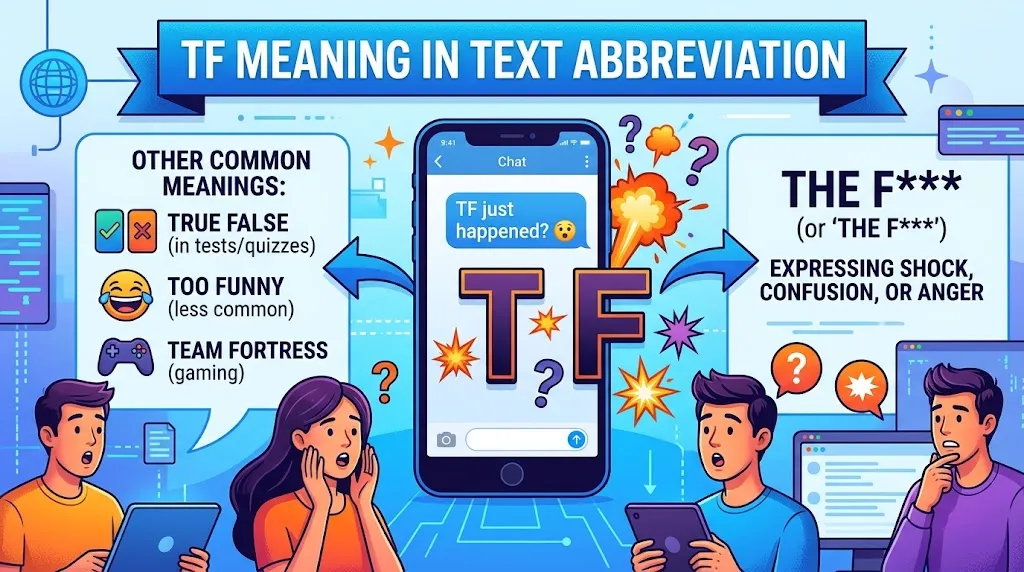
In texting and online slang, TF usually means “the fuck.” It is an abbreviation based on a profanity and is mainly used to make a question, reaction, or statement sound stronger.
For example:
- “What TF happened?”
- “Why TF are you late?”
- “How TF did you do that?”
- “Who TF is that?”
- “TF?”
In these examples, TF does not add a new fact to the sentence. Instead, it adds emotion.
It can make a message sound more shocked, confused, annoyed, surprised, or intense.
The exact feeling depends on the words around TF and the relationship between the people talking. A friend may use it as a joke, while the same phrase could sound rude during an argument.
TF Meaning in Text Message
When someone searches for TF meaning in text message, they are usually asking about the slang abbreviation.
In a normal text conversation, TF is commonly used as an emotional intensifier. It can turn a simple question into a much stronger reaction.
Compare these examples:
“What happened?”
This sounds neutral.
“What TF happened?”
This sounds much more surprised, confused, or frustrated.
Another example:
“Why are you doing that?”
This can sound calm.
“Why TF are you doing that?”
This sounds more emotional and may come across as annoyed.
So, TF often works like an emotional boost. The surrounding sentence tells you exactly how the sender feels.
What Does TF Stand For?
In internet slang, TF stands for “the fuck.” The phrase contains profanity, which is why TF is considered informal and can sound rude.
People often use the abbreviation instead of writing the full phrase. This makes the message shorter while still communicating strong emotion.
Common uses include:
- What TF — strong confusion or surprise
- Why TF — frustration or disbelief
- How TF — surprise about how something happened
- Who TF — strong questioning
- Where TF — confusion about a location
- TF? — a short reaction to something strange or unexpected
The meaning is usually clear from context.
What Emotions Can TF Express?
TF does not always mean exactly the same emotion. It can communicate several different reactions.
1. Surprise
Someone may use TF after seeing something unexpected.
Example:
“TF? You actually won?”
Here, TF shows surprise.
2. Confusion
TF can show that someone does not understand what is happening.
Example:
“What TF is going on?”
The sender is confused about the situation.
3. Frustration
It can also show annoyance.
Example:
“Why TF is my computer doing this?”
The person is frustrated by the problem.
4. Disbelief
Someone may use TF when they find something difficult to believe.
Example:
“How TF did that happen?”
The sender is surprised or doubtful about what happened.
5. Humor
Friends sometimes use TF in a funny or playful way.
Example:
“TF 😂”
The person may simply be reacting to something funny or unexpected.
Because tone is important, you should look at the entire conversation before deciding exactly what the sender means.
TF Meaning in Chat
The TF meaning in chat is generally the same as its meaning in texting.
You may see it in casual online conversations when someone wants to react quickly.
For example:
Person A: “I just found out our class is canceled.”
Person B: “TF? Seriously?”
Here, TF expresses surprise.
Another example:
Person A: “I deleted the file by accident.”
Person B: “Why TF did you do that?”
Here, TF makes the question sound more frustrated.
A short message such as “TF?” can also stand alone. In that case, it often means something like:
- “What?”
- “Seriously?”
- “What is happening?”
- “How did that happen?”
The exact meaning depends on the situation.
Common TF Examples in Texting
Here are some common examples and what they usually communicate.
| Text Example | Likely Meaning |
| “TF?” | Shock or confusion |
| “What TF?” | Strong confusion |
| “What TF happened?” | Surprise or confusion |
| “Why TF did you do that?” | Frustration |
| “How TF did you win?” | Surprise or disbelief |
| “Who TF is that?” | Strong curiosity or questioning |
| “Where TF are you?” | Frustration or urgency |
| “TF is this?” | Confusion or disbelief |
| “No TF way!” | Strong disbelief |
| “TF 😂” | Funny surprise or disbelief |
These examples show why context matters. The same abbreviation can have a different tone in different conversations.
What Does TF Mean on Social Media?
On social media, TF is commonly used as casual internet slang.
You may see it in comments, replies, captions, or private messages. People often use it when reacting to something surprising, funny, confusing, or frustrating.
For example:
“What TF am I looking at?”
This can express confusion.
Another example:
“How TF did you manage that?”
This could show genuine surprise or playful disbelief.
Because social media conversations are usually informal, abbreviations like TF are common. However, the fact that a term is common does not mean it is appropriate in every situation.
TF Meaning in Text From a Friend
If a friend sends you “TF?” or uses TF in a message, the meaning is usually emotional rather than literal.
For example:
Friend: “I forgot we had a test today.”
You: “TF 😭”
This could simply mean you are shocked by the situation.
But if a friend says:
“Why TF did you tell everyone?”
the tone may be more serious or annoyed.
The relationship between the speakers matters. Friends who regularly joke with each other may use stronger slang without intending to offend. The same words from a stranger may feel much more aggressive.
Is TF Rude?
TF can be rude or offensive because it represents profanity.
That does not mean every person who uses it intends to insult someone. In casual conversations, people may use TF simply to express surprise or frustration.
Still, it is best treated as informal and potentially offensive slang.
For example:
“What TF happened?”
may sound normal between close friends.
But using the same wording with a teacher, employer, customer, or other professional contact could be inappropriate.
Several references on texting slang also describe TF as informal and recommend avoiding it in professional communication.
Is TF Appropriate for School or Work?
Usually, no.
TF is based on profanity, so it is better to avoid it in:
- School assignments
- Formal emails
- Job applications
- Business messages
- Customer service communication
- Professional reports
- Official documents
Instead, use clearer and more respectful alternatives.
For example:
Instead of:
“What TF happened?”
Use:
“What happened?”
Instead of:
“Why TF did this happen?”
Use:
“Why did this happen?”
Instead of:
“How TF did you do that?”
Use:
“How did you do that?”
These alternatives communicate the same basic question without the strong slang.
TF vs. WTF
TF and WTF are closely related, but they are not always used in exactly the same way.
TF is commonly placed inside a sentence or used as a short reaction.
Examples:
- “What TF happened?”
- “Why TF are you here?”
- “How TF did you know?”
WTF is often used as a complete reaction or as part of a phrase.
Examples:
- “WTF?”
- “WTF is happening?”
- “WTF was that?”
Both are informal and contain profanity.
The difference is mainly how the abbreviation is placed in the sentence.
TF vs. “What the Heck”
If you want a cleaner alternative, phrases such as “what the heck”, “what in the world,” or simply “what happened?” can work.
For example:
TF is going on?
can become:
What the heck is going on?
Or:
What is going on?
The second version is the most neutral.
This is useful when you want to show surprise without using profanity.
Does TF Always Mean “The Fuck”?
No. Context matters.
In ordinary texting and internet slang, TF usually has the profanity-based meaning. But in technical, business, gaming, academic, or professional contexts, TF can stand for other terms.
For example, depending on the subject, TF can refer to an abbreviation unrelated to texting slang.
Possible meanings can include terms such as:
- Transfer function
- Task force
- TensorFlow
- Time frame
Therefore, do not automatically assume every “TF” means the slang expression.
If the conversation is about programming, engineering, business, science, or another specialized subject, check the surrounding context first.
How to Understand TF From Context
If you see TF in a message and are unsure about its meaning, look at three things.
1. Look at the words around it
Words such as “what,” “why,” “how,” and “who” often signal the slang use.
Example:
“Why TF are you laughing?”
This clearly uses TF as an emotional intensifier.
2. Look at the conversation
If people are discussing memes, jokes, games, or everyday events, TF is more likely to be internet slang.
3. Consider the sender
A close friend may use TF casually. A teacher, manager, or professional contact may be using TF as an abbreviation for something else.
Context is the best way to avoid misunderstanding.
How Should You Reply to “TF?”
Your reply depends on what the sender is asking.
If someone sends:
“TF?”
you could respond with a simple explanation.
For example:
“I was just surprised by what happened.”
If someone says:
“What TF happened?”
you can simply explain what happened.
If the message sounds angry, it may be better to respond calmly instead of matching the same tone.
For example:
“Nothing serious. Let me explain.”
This can help prevent a small misunderstanding from becoming an argument.
Common Phrases With TF
TF often appears with question words.
“What TF”
Usually shows confusion or disbelief.
Example:
“What TF is that?”
“Why TF”
Usually shows frustration.
Example:
“Why TF did the meeting start early?”
“How TF”
Usually shows surprise.
Example:
“How TF did you finish so fast?”
“Who TF”
Usually shows strong curiosity, surprise, or disbelief.
Example:
“Who TF sent this?”
“Where TF”
Usually shows confusion or frustration.
Example:
“Where TF did you put my book?”
Again, the tone can change based on the conversation.
Related Searches for TF Meaning
People looking for tf mean in text may also search for related questions such as:
- What does TF mean in texting?
- What does TF stand for?
- What does TF mean in chat?
- TF meaning slang
- What does TF mean in a text message?
- Is TF rude?
- What does TF mean on social media?
- What does TF mean from a girl?
- What does TF mean from a guy?
- TF slang meaning
- What does “TF?” mean?
- What is the difference between TF and WTF?
These searches usually have the same basic intent: understanding the abbreviation and its tone in a specific conversation.
People Also Ask About TF
What does TF mean in texting?
TF usually means a shortened form of “the fuck.” It is informal slang used to show surprise, confusion, frustration, disbelief, or strong emphasis.
What does TF mean in a text message?
In a text message, TF is usually an emotional slang abbreviation. The exact tone depends on the sentence and context.
Is TF a bad word?
TF represents profanity, so it can be considered inappropriate or rude in some situations. It is best kept to casual conversations where that language is accepted.
Is TF the same as WTF?
They are closely related. Both use the same profanity-based expression, but TF can be inserted into a sentence, while WTF is often used as a complete reaction.
What does “TF?” mean by itself?
“TF?” is usually a short reaction showing surprise, confusion, disbelief, or annoyance. It can be similar to saying “What?” or “Seriously?”
Can I use TF in a formal email?
It is best not to. TF is informal slang based on profanity. A neutral phrase such as “What happened?” is more suitable for formal communication.
What does TF mean on social media?
On social media, TF usually has the same slang meaning. It is commonly used to express shock, confusion, frustration, disbelief, or humor.
Can TF have other meanings?
Yes. Outside slang, TF can represent different technical or professional terms. The subject of the conversation determines which meaning is correct.
Article Summary
TF meaning in text is usually a shortened form of “the fuck,” used as informal internet slang. People use it to add strong emotion to questions, statements, and reactions.
TF can express:
- Surprise
- Confusion
- Frustration
- Disbelief
- Shock
- Humor
- Strong emphasis
For example, “What TF happened?” is much more emotional than “What happened?”
TF is common in casual texting and online conversations, but it is based on profanity. Because of this, it may sound rude or inappropriate in formal settings.
The most important point is context. TF can have different meanings outside internet slang, so always consider the conversation before deciding what it means.
Conclusion
The tf meaning in text is usually a slang abbreviation for “the fuck.” It is used in casual digital communication to add emotion to a question, reaction, or statement. Depending on the context, it can show surprise, confusion, frustration, disbelief, or humor.
You may see TF in text messages, chats, comments, and other informal conversations. However, because it represents profanity, it is not a good choice for formal writing, school work, or professional communication.
If you receive a message containing TF, look at the surrounding words and the overall tone before deciding what the sender means. In most casual texting situations, TF is simply an informal way to make a reaction stronger.

Olivia Bennett is a dedicated content writer passionate about slang, word meanings, and digital communication. She creates simple and helpful content to make language easy for everyone to understand.