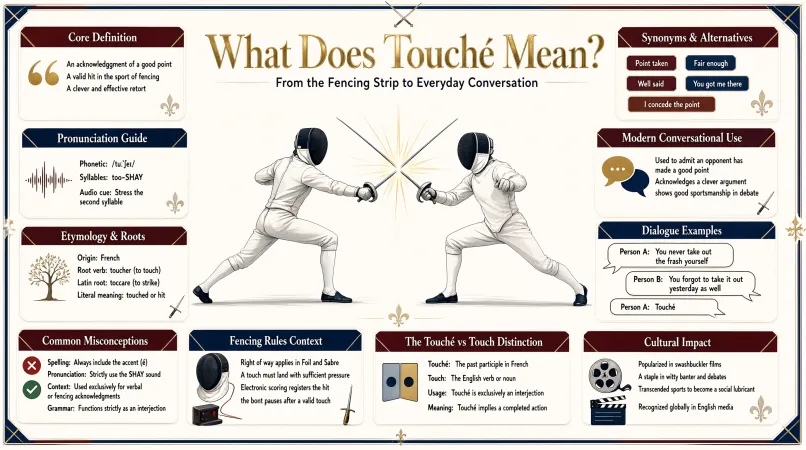
The word touché is usually used as a short response when someone makes a clever, accurate, or effective point.
In everyday English, “Touché!” can mean:
- “Good point.”
- “You got me.”
- “That’s true.”
- “Fair point.”
- “I have to admit you are right.”
- “Nice comeback.”
For example:
Person A: “You tell me to stop being late, but you were late yesterday.”
Person B: “Touché.”
Here, Person B admits that Person A made a fair point.
Touché does not always mean that the other person has completely won an argument. It often means that you recognize one particular point was strong or clever.
Merriam-Webster defines touché as an expression used to acknowledge a hit in fencing or the success or appropriateness of an argument, accusation, or witty point.
Touché Meaning in Simple Words
If you want the easiest possible definition:
Touché means “You made a good point” or “You got me with that comeback.”
It is often used in a playful or friendly way.
Imagine you say:
“You should clean your room.”
Your friend replies:
“You should clean your desk first.”
You might smile and say:
“Touché.”
You are not necessarily angry. Instead, you are admitting that your friend made a fair comeback.
What Does Touché Mean in Text?
In texting, touché has almost the same meaning as it does in spoken English.
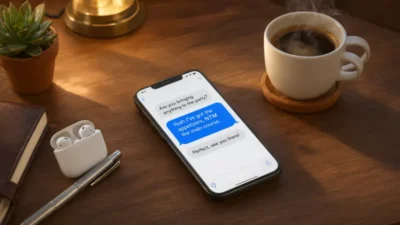
Someone may type “touché” after you make a clever comeback, point out a contradiction, or turn their own argument back on them.
Example 1
You: “You always tell me to save money.”
Friend: “And you bought three new games this week.”
You: “Touché.”
Meaning: “Okay, you got me. That is a fair point.”
Example 2
Friend: “You said you were going to study early.”
You: “At least I started.”
Friend: “At midnight.”
You: “Touché.”
Here, the person accepts the criticism in a lighthearted way.
Is Touché a Slang Word?
Touché is not really slang. It is a French word that has been adopted into English.
People often use it casually in conversations, jokes, debates, online discussions, and text messages. It can sound witty or playful because it is a short foreign-language expression.
What Is the Literal Meaning of Touché?
The literal French meaning of touché is related to “touched” or “hit.”
The word comes from the French verb toucher, which means “to touch.” Touché is the past participle form of that verb.
The modern English expression developed from the language of fencing.
In fencing, a successful hit is called a touch. The word touché was used to acknowledge that a hit had been made. From this idea of acknowledging a successful hit, English speakers began using the word for a successful verbal point or comeback.
So you can think of the modern meaning like this:
Physical hit → fencing “touch” → clever verbal hit → “Touché!”
Where Did Touché Come From?
Touché comes from French.

Its connection to fencing is important because it explains why people use the word after a strong argument or comeback.
Imagine two people fencing. One person makes a successful hit. The hit is acknowledged with “touché.”
Later, the idea was used figuratively. Instead of someone being hit by a sword, they were “hit” by a clever argument.
That is why “Touché!” can feel like saying:
“That was a good hit.”
Only the “hit” is verbal rather than physical.
English dictionaries recognize this fencing-based origin and the later conversational meaning. Merriam-Webster lists the English word as an interjection and traces it to French, from the past participle of toucher, “to touch.”
How Do You Pronounce Touché?
Touché is commonly pronounced:
too-SHAY
The French pronunciation is represented as approximately /tu.ʃe/.
The final é gives the word its “ay” sound.
Easy pronunciation guide
Touché = too-SHAY
Do not pronounce it like the English word “touch.”
The difference is important:
- touch = an English word
- touché = French word used in English
- touche = often the keyboard-friendly spelling without the accent
Touché vs. Touche: What Is the Difference?
You may see both touché and touche online.
The standard French spelling is touché, with an accent over the final e.
However, people sometimes type touche because they do not have an easy way to enter the accent mark or simply leave it out in casual messages.
For example:
Standard: “Touché!”
Casual typing: “Touche!”
When discussing the French expression, touché is the preferred spelling.
There is also a separate French word touche without the accent, so the missing accent can matter in French. The word “touche” has several French meanings depending on context, including a key, stroke, touch, or other specialized uses.
What Does Touché Mean in an Argument?
In an argument, “touché” usually means:
“That is a strong point, and I cannot easily argue against it.”
It can show that you recognize the other person’s argument without saying that you agree with everything they believe.
For example:
Person A: “You said I should answer my messages faster, but you ignored mine all day.”
Person B: “Touché.”
Person B is admitting that the other person’s response is fair.
Touché can make an argument lighter
A friendly “touché” can help turn a tense discussion into a joke.
It can communicate:
- I see your point.
- That was a clever response.
- You caught me.
- I respect that comeback.
- I do not have a better response right now.
But tone matters. If someone is discussing a serious problem, saying “touché” may sound dismissive.
Touché Examples in Everyday Conversation
Here are some simple examples.
Example 1: Being late
Friend: “You always tell me to arrive on time.”
You: “Because you are always late.”
Friend: “You arrived late yesterday.”
You: “Touché.”
Meaning: “Fair point. You got me.”
Example 2: Studying
Student A: “You should study instead of watching videos.”
Student B: “You watched videos for two hours yesterday.”
Student A: “Touché.”
Meaning: “Okay, that’s a fair comeback.”
Example 3: Food
Person A: “You always tell me not to eat junk food.”
Person B: “You ordered fries five minutes ago.”
Person A: “Touché.”
Meaning: “You have a point.”
Example 4: Social media
Friend A: “You spend too much time on social media.”
Friend B: “You sent me 30 reels today.”
Friend A: “Touché.”
Meaning: “You caught me.”
Example 5: Friendly debate
Person A: “This movie is too long.”
Person B: “You watched the director’s cut last week.”
Person A: “Touché.”
Meaning: “That’s a good counterpoint.”
When Should You Use Touché?
Use “touché” when someone makes a clever or valid response to something you said.
It works especially well when:
- Someone points out your contradiction.
- Someone gives a clever comeback.
- Someone turns your argument back on you.
- You realize their point is difficult to challenge.
- You want to admit a small loss in a friendly debate.
- You want to respond humorously.
The word is most natural when the conversation is light or playful.
When Should You Not Use Touché?
Although “touché” can be funny, it is not suitable for every situation.
Avoid using it when someone is talking about serious pain, personal problems, or an important concern.
For example, imagine someone says:
“What you said really hurt my feelings.”
Responding with:
“Touché.”
would probably sound rude or dismissive.
A better response would be:
“I’m sorry. I understand why that hurt you.”
So, “touché” is best for a clever point or playful disagreement, not for avoiding responsibility in a serious conversation.
Is Touché Positive or Negative?
The word itself is generally neutral to positive, but the tone can change its meaning.
Positive or playful
Someone gives a clever comeback.
“Touché!”
This can show respect or amusement.
Neutral
Someone makes a valid argument.
“Touché. You have a point.”
This clearly shows acknowledgment.
Negative or sarcastic
Someone uses the word to mock another person.
“Touché, genius.”
Depending on tone, this could be sarcastic.
Therefore, the meaning depends not only on the word but also on the situation, relationship, and tone.
Is Touché Formal or Informal?
Touché is generally casual or conversational.
You may see it in:
- Friendly conversations
- Text messages
- Social media
- Movies and TV
- Informal debates
- Jokes
- Casual writing
It is not normally the best choice for a formal business email or academic paper.
Instead of writing:
“Touché!”
in a formal discussion, you could say:
“That is a fair point.”
or:
“I understand your argument.”
Touché Synonyms
There is no single English word that matches “touché” perfectly in every situation.
Depending on the context, you can use:
- Good point
- Fair point
- You got me
- That’s true
- Fair enough
- I see your point
- Nice comeback
- You have a point
- Well said
- I can’t argue with that
Touché vs. “Good Point”
“Good point” is more direct and common.
Touché: “You made a clever or effective point.”
Good point: “What you said is valid or useful.”
They are often interchangeable in casual conversation.
Touché vs. “Fair Enough”
“Fair enough” usually means that you accept something as reasonable.
“Touché” often has a stronger connection to a clever comeback.
Touché vs. “You Got Me”
“You got me” is very informal and directly admits that someone caught you.
“Touché” can communicate a similar idea but sounds more witty or playful.
Does Touché Mean “You Are Right”?
Sometimes, but not always.
This is an important distinction.
When you say “touché,” you are usually acknowledging a specific point, not necessarily agreeing with everything the other person said.
For example:
Person A: “You should exercise more.”
Person B: “You don’t exercise either.”
Person A: “Touché.”
Person A is admitting that Person B made a fair criticism of Person A’s behavior.
That does not automatically mean Person A believes the original statement was wrong.
So the best simple explanation is:
Touché means “You made a good point,” rather than simply “You are completely right.”
Touché in Social Media and Online Conversations
You may see “touché” in comments, posts, and online discussions.
People often use it after someone gives a clever reply.
For example:
Comment 1: “You say you hate spoilers, but you read the comments.”
Comment 2: “Touché.”
Online, the word often works as a short way to acknowledge a strong comeback.
Because social media conversations are usually fast, “touché” can replace a longer response such as:
“Okay, you actually have a good point there.”
Touché in Movies and TV Shows
You may also hear “touché” in movies, television shows, comedy, and other entertainment.
Writers often use it because the word quickly shows that one character has made a clever argument or comeback.
For example:
Character A: “You said you never lie.”
Character B: “You believed that?”
Character A: “Touché.”
The expression helps show that Character A recognizes the clever response.
Common Mistakes With Touché
Mistake 1: Thinking it means “touch”
Touché is related to the French verb toucher, but the English expression “Touché!” usually means “good point” or “you got me.”
Mistake 2: Using it after every comment
Not every statement deserves “touché.”
It works best when someone makes a strong, clever, or unexpected point.
Mistake 3: Using it during a serious issue
If someone is genuinely upset, “touché” can sound like you are making fun of their feelings.
Mistake 4: Thinking it means complete defeat
Saying “touché” does not always mean you lost the entire argument.
It usually acknowledges one effective point.
Mistake 5: Forgetting the pronunciation
The common pronunciation is too-SHAY, not the English pronunciation of “touch.”
Touché in French vs. English
There is an interesting difference between the French word and its common English use.
In English, people often use touché! as a standalone expression after a clever point.
In French, touché has broader grammatical uses because it is the past participle of toucher. It can refer to being touched, hit, or emotionally affected, depending on the sentence.
For example, the French expression can describe someone being emotionally moved by something.
This means the English conversational use is only one part of the word’s meaning in French.
What Does Touché Mean From a Girl?
If a girl texts you “touché,” the basic meaning does not change.
She is probably acknowledging that you made a clever, fair, or accurate point.
For example:
You: “You said you don’t like texting, but you sent me 20 messages today.”
Her: “Touché.”
She likely means:
“Okay, you got me.”
Do not automatically assume that “touché” has a romantic meaning. The context of the conversation matters much more than the word itself.
What Does Touché Mean From a Guy?
If a guy says “touché,” the meaning is also usually the same.
He may be saying:
- “Good point.”
- “You got me.”
- “That’s fair.”
- “I can’t argue with that.”
- “Nice comeback.”
The word itself does not indicate a specific relationship or emotion.
Is Touché Used in Texting?
Yes. People can use “touché” in text messages, chats, and online conversations.
Because it is short, it works well when someone wants to acknowledge a clever response without writing a long explanation.
For example:
You: “You told me to sleep early, but you’re still online.”
Friend: “Touché 😂”
The emoji is optional. The word itself already communicates the main idea.
Frequently Asked Questions
What does touché mean in simple English?
Touché means “good point,” “fair point,” or “you got me.” It is often used when someone makes a clever or difficult-to-answer comeback.
What does touché mean in texting?
In texting, touché usually means that the other person’s response was clever or fair. It can be understood as “Okay, you got me” or “That’s a good point.”
Is touché a French word?
Yes. Touché is French and comes from the verb toucher, meaning “to touch.” The English conversational use is linked to fencing.
How do you pronounce touché?
Touché is commonly pronounced too-SHAY, approximately /tu.ʃe/.
Is touché a compliment?
It can be a form of acknowledgment or respect. When someone says “touché” after your comeback, they are usually admitting that you made a good point.
Does touché mean “I agree”?
Not necessarily. It usually means the person recognizes that your particular point is strong or fair.
Is touché rude?
Usually not. It is often playful or respectful. However, it can sound rude or dismissive if used when someone is discussing a serious personal issue.
Can I say touché in an argument?
Yes, especially during a friendly or lighthearted argument. It means you recognize that the other person made a strong point.
What is another word for touché?
Depending on the context, you can say “good point,” “fair point,” “you got me,” “fair enough,” or “I see your point.”
Is “touche” without the accent correct?
The standard French spelling of the conversational expression is touché. People often write “touche” online when they leave out the accent mark.
What is the origin of touché?
The expression comes from French fencing terminology. It originally acknowledged a successful hit. English later adopted it as a way to acknowledge a clever verbal point.
Does touché mean “touched”?
Literally, touché is related to the French word for “touched.” In modern English conversation, however, “Touché!” usually means “good point” or “you got me.”
Article Summary
Touché is a French expression commonly used in English to acknowledge a clever, accurate, or effective point. In simple words, it means “good point,” “fair point,” or “you got me.”
The word comes from French fencing, where it was connected with acknowledging a successful hit. English speakers later began using it for a strong verbal comeback.
In texting and casual conversation, “touché” is usually playful. It does not necessarily mean that someone completely lost an argument. Instead, it often means that they admit the other person made one strong point.
The standard spelling is touché, and it is commonly pronounced too-SHAY. It is best used in friendly or light conversations rather than serious situations.
Conclusion
The touché meaning is simple: it is a way to acknowledge that someone has made a good, clever, or hard-to-answer point. You can think of it as saying, “Good point,” “Fair enough,” or “You got me.”
The word comes from French and has roots in fencing, where it was connected to a successful hit. Today, English speakers use it in conversations, arguments, text messages, social media, movies, and jokes.
If someone gives you a smart comeback and you realize they have a fair point, a simple “Touché!” can be the perfect response.

Olivia Bennett is a dedicated content writer passionate about slang, word meanings, and digital communication. She creates simple and helpful content to make language easy for everyone to understand.