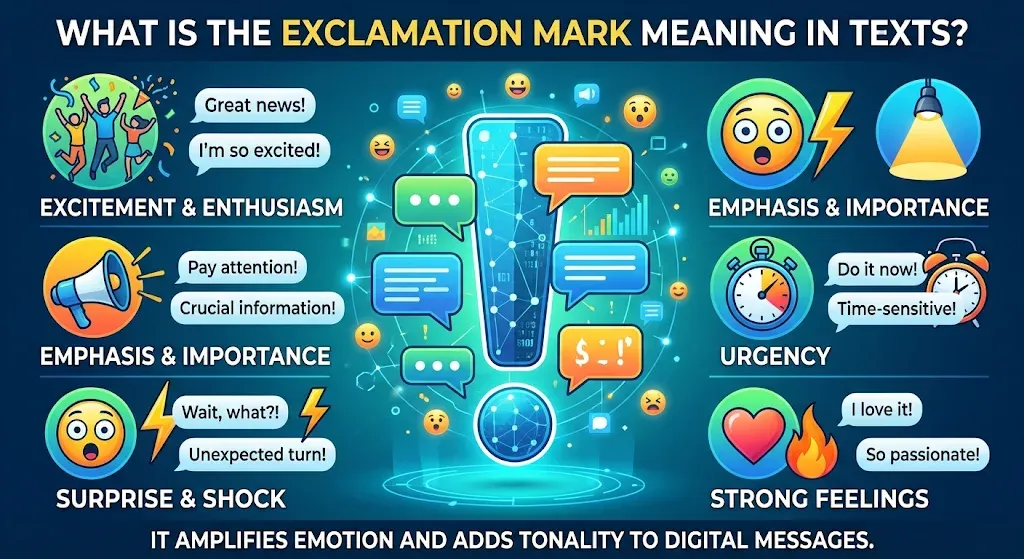
An exclamation mark (!) is a punctuation symbol used to show strong feelings or add emphasis to a statement. In text messages, it can help readers understand the tone behind the words.
People often use it when they want a message to sound more excited, friendly, surprised, or serious.
Common Meanings of an Exclamation Mark
An exclamation mark can have several meanings:
- Excitement: “I won!”
- Happiness: “That is wonderful!”
- Surprise: “You are here!”
- Anger: “Leave me alone!”
- Urgency: “Call me now!”
- Friendliness: “Thanks for helping!”
- Emphasis: “This is really important!”
The symbol does not have one fixed meaning in every conversation. The words around it help explain what the sender wants to say.
What Does (!) Mean in a Text Message?
The symbol (!) usually adds feeling or strength to a message. It can make a short sentence sound more lively or more forceful.
For example:
- “Good morning.” — A simple greeting.
- “Good morning!” — A greeting that may feel warmer or more cheerful.
- “Good morning!!!” — Extra excitement, strong enthusiasm, or a more dramatic tone.
These are common patterns, not strict rules. Some people use exclamation marks often, while others rarely use them.
Why Do People Use Exclamation Marks in Texts?
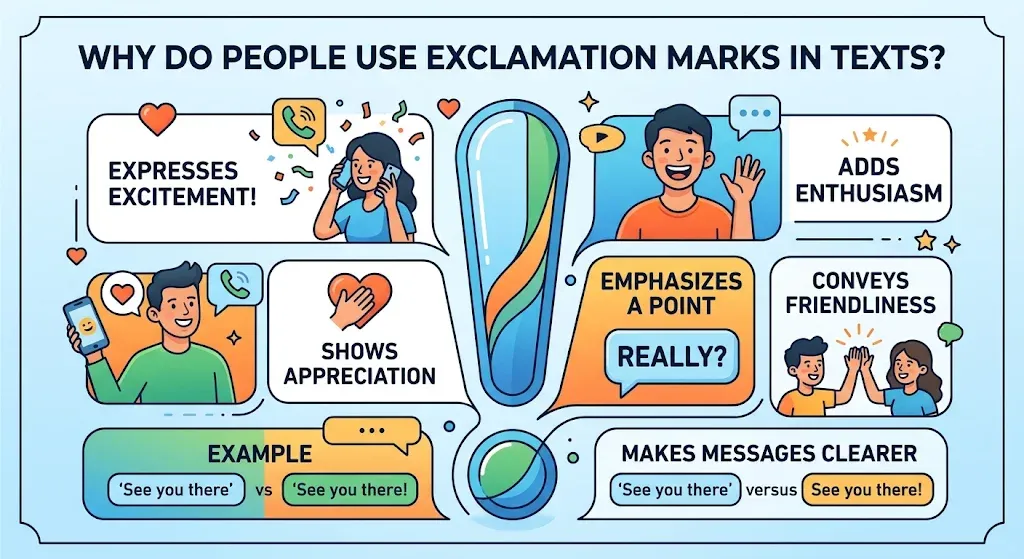
People use exclamation marks because text messages do not include a voice, facial expression, or body language. Punctuation can help show how a message might sound.
1. To Show Excitement
An exclamation mark often shows that someone is excited about something.
Example:
Person A: “We are going to the beach tomorrow!”
Person B: “That sounds amazing!”
Both people use the mark to share their excitement.
2. To Show Happiness
People may add an exclamation mark when sharing good news or responding to something nice.
Example:
“Your gift arrived!”
“I’m so happy for you!”
The punctuation adds a positive feeling to both messages.
3. To Show Surprise
An exclamation mark can show that something is unexpected.
Example:
“You met my favorite singer!”
“Wait, you won the contest!”
In these examples, the mark helps show surprise or amazement.
4. To Make a Message Sound Friendly
A short message can sometimes seem cold without extra context. An exclamation mark may make it feel more welcoming.
Example:
“Thanks for your help!”
“See you tomorrow!”
These messages may sound warm and cheerful. However, friendliness depends on the whole conversation, not just punctuation.
5. To Add Emphasis
People also use exclamation marks to make an important point stand out.
Example:
“Remember to bring your homework!”
“Please read this message carefully!”
The mark tells the reader that the words deserve attention.
6. To Show Urgency or Strong Feelings
An exclamation mark may also appear in warnings, urgent requests, or strong reactions.
Example:
“Watch out!”
“Stop right there!”
Here, the mark makes the message sound forceful. It does not necessarily mean the sender is angry.
What Does an Exclamation Mark Mean From a Girl?
When a girl uses an exclamation mark in a text, it may show excitement, friendliness, happiness, or emphasis. The symbol alone does not reveal her feelings toward the person receiving the message.
If She Sends “Hey!”
A message like “Hey!” may sound cheerful or welcoming. She might simply be starting the conversation in a friendly way.
Example:
You: “Hey!”
Her: “Hey!”
This can be a normal, friendly exchange. It is not enough to tell whether she likes you romantically.
If She Says “Thank You!”
“Thank you!” often sounds warm and appreciative.
She may be showing genuine gratitude or using her usual texting style.
If She Sends “Really?!”
This may show surprise, excitement, or disbelief. The meaning depends on what you told her and how she usually texts.
If She Uses Many Exclamation Marks
A message like “That is so cool!!!” may show strong excitement. Some people use several marks with friends because they enjoy expressive texting.
Remember: Do not judge someone’s feelings based on one punctuation mark. Look at the full conversation and respect what the person actually says.
What Does an Exclamation Mark Mean From a Guy?
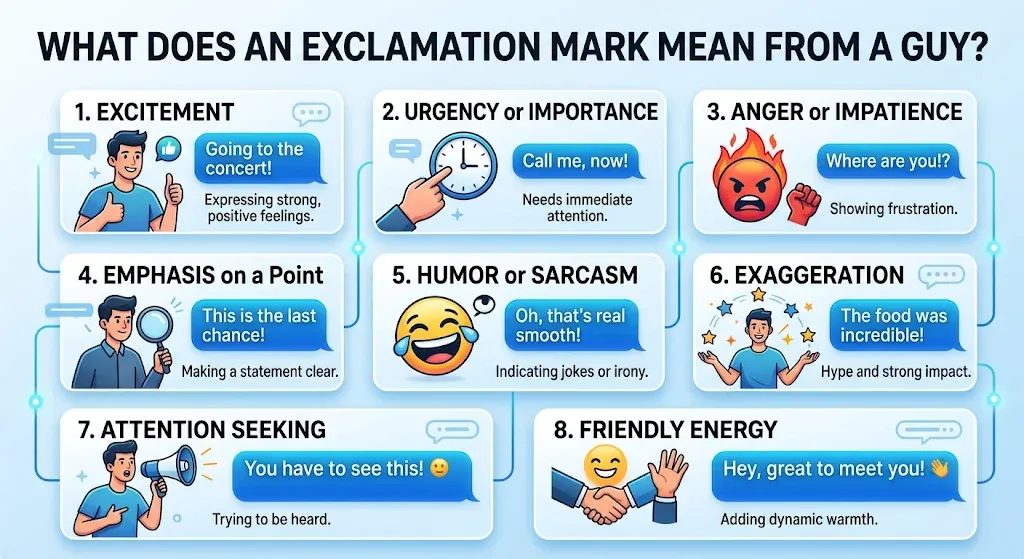
When a guy uses an exclamation mark, it can have the same basic meanings as when anyone else uses one. It may show enthusiasm, friendliness, surprise, or emphasis.
If He Texts “Hey!”
He may be greeting you in a friendly or energetic way. It does not automatically mean he is flirting.
If He Says “That Was Awesome!”
This usually suggests that he enjoyed something or feels positive about it.
If He Writes “Fine!”
The meaning is less clear. Depending on the conversation, it may sound firm, annoyed, or simply brief.
For example, a person may write “Fine!” because they agree, while another may use it when upset. The surrounding messages matter more than the symbol alone.
If He Uses Exclamation Marks Often
Some people naturally use expressive punctuation in nearly every conversation. If a guy regularly writes “Thanks!”, “Sure!”, and “See you!”, that may simply be his normal style.
It is better to consider his words, actions, and communication habits instead of assuming that punctuation reveals his intentions.
What Is the Difference Between ! and . in Text Messages?
An exclamation mark and a period can express the same basic idea but create different tones.
| Text message | Possible tone |
| “Okay.” | Neutral, calm, or formal |
| “Okay!” | Friendly, positive, or enthusiastic |
| “Thanks.” | Simple or direct |
| “Thanks!” | Warm or appreciative |
| “I did it.” | A plain statement |
| “I did it!” | Excited or proud |
| “Stop.” | Direct instruction |
| “Stop!” | Strong warning or urgent command |
These differences are not universal. A period is not automatically rude, and an exclamation mark is not always friendly.
Does a Period Sound Rude in Texts?
Not always. A period is normal punctuation in writing. However, in some casual conversations, a short reply such as “Okay.” may feel more serious than “Okay!”
That impression can come from the conversation, the relationship, or a change in someone’s usual texting style. It is not proof that the sender is upset.
Is an Exclamation Mark More Positive Than a Period?
It can sound more energetic or expressive, but it is not always positive. Compare “That’s great!” with “Get out!” Both use an exclamation mark, but their feelings are very different.
The words determine the main message, while punctuation helps shape its tone.
What Does One, Two, or Three Exclamation Marks Mean?
What Does One, Two, or Three Exclamation Marks Mean?
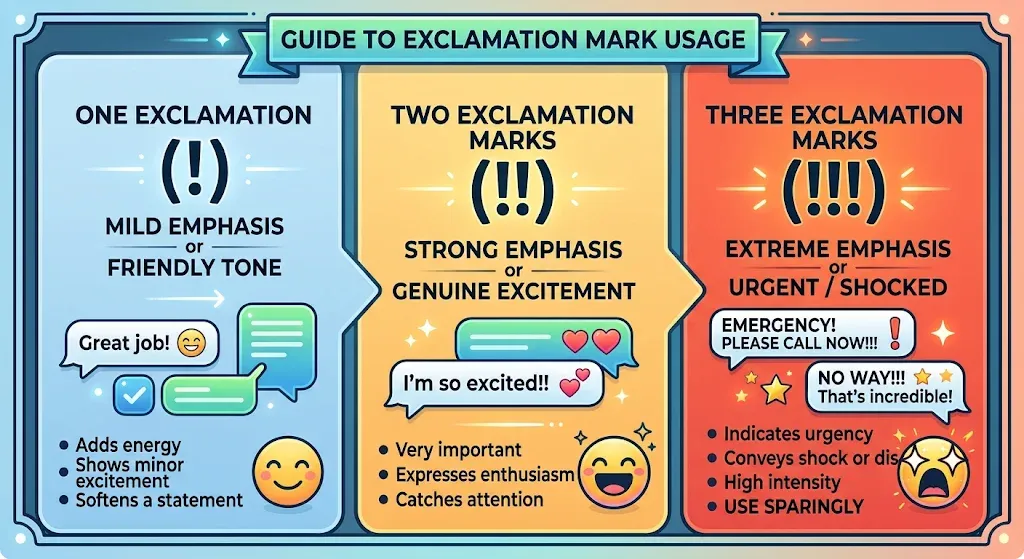
The number of exclamation marks can change how a text feels. Still, there is no official rule that gives each number a separate emotional meaning.
One Exclamation Mark (!)
One mark is common in everyday texting. It can show happiness, excitement, friendliness, or emphasis.
Examples:
- “Thank you!”
- “See you soon!”
- “I passed my test!”
One mark is often enough to make a message feel more expressive.
Two Exclamation Marks (!!)
Two marks may show stronger excitement or surprise than one.
Examples:
- “You did it!!”
- “That is amazing!!”
- “We won!!”
The sender may feel very happy or want to make their reaction stand out. However, two marks do not always mean stronger feelings.
Three or More Exclamation Marks (!!!)
Several marks can show high energy, excitement, shock, or a strong reaction.
Examples:
- “Happy birthday!!!”
- “No way!!!”
- “This is incredible!!!”
People often use repeated marks in casual chats, group messages, and social media posts. In some situations, too many marks may seem dramatic or overly intense.
Can Multiple Exclamation Marks Mean Anger?
Yes, they can. For example, “I told you to stop!!!” may sound angry or forceful.
But “We are going on vacation!!!” sounds excited. The words and situation help determine the meaning.
What Does an Exclamation Mark Mean at the End of a Message?
An exclamation mark at the end of a text often adds emotion or emphasis to the complete message. Its meaning depends on the sentence.
“Thank You!”
This usually expresses thanks in a warm or lively way.
“Good Night!”
This may sound friendly, kind, or cheerful.
“I Miss You!”
This adds emotional emphasis to the words. It can express affection, but the mark alone does not explain the sender’s full feelings.
“Leave Me Alone!”
This sounds strong and may show frustration or a clear demand for space.
“Whatever!”
Depending on the conversation, this can sound dismissive, annoyed, playful, or casual. More context is needed to understand the sender’s tone.
What Does an Exclamation Mark Mean in Different Types of Texts?
The same symbol can have different meanings depending on who is talking and what they are discussing.
In Texts Between Friends
Friends often use exclamation marks to show excitement and keep conversations lively.
Example:
“Guess what!”
“What happened?”
“I got tickets!”
Here, the marks help show excitement and interest.
In Romantic Conversations
In a romantic conversation, an exclamation mark may make a message sound more enthusiastic or affectionate.
Example:
“Can’t wait to see you!”
This sounds excited, but it does not prove anything beyond the words themselves.
In Work Messages
At work, an exclamation mark may make a message sound friendly or positive.
Example:
“Thanks for sending the report!”
However, using too many marks in a formal email may feel less professional. One mark can be useful when the tone calls for it.
In Group Chats
Group chats often include expressive punctuation because people react quickly to news, jokes, photos, and plans.
Example:
“Everyone is coming tonight!”
The exclamation mark may show excitement or help draw attention to the plan.
On Social Media
People use exclamation marks in comments, captions, and posts to make reactions stand out.
Examples:
- “Love this photo!”
- “What an amazing day!”
- “New video is live!”
In social media writing, repeated exclamation marks can also help create an energetic style.
Can an Exclamation Mark Mean Sarcasm?
Yes. An exclamation mark can sometimes appear in a sarcastic message, especially when the words suggest the opposite of what the sender means.
Example:
“Great job!”
If someone has made a mistake and the other person sends “Great job!”, the message could be sincere or sarcastic. The situation and previous messages help explain it.
Another example is:
“Oh, wonderful!”
If the sender is dealing with a problem, this might be a sarcastic reaction rather than real excitement.
However, punctuation alone cannot confirm sarcasm. If the meaning is unclear, it is better not to assume the sender is making fun of you.
Does an Exclamation Mark Mean Someone Is Angry?
Not necessarily. An exclamation mark can show anger, but it can also show happiness, surprise, excitement, or urgency.
Compare these examples:
- “That is fantastic!” — Often positive.
- “Watch out!” — A warning.
- “Don’t do that!” — A strong instruction.
- “I can’t believe it!” — Surprise or disbelief.
- “Leave me alone!” — May show anger or a need for space.
The best way to understand the message is to read the words and consider what happened before it.
Signs That a Message May Sound Angry
A message might sound angry if it includes:
- Strong or harsh words.
- A clear complaint.
- A demand or warning.
- Several forceful statements in a row.
- A tense conversation that came before the message.
These are clues, not proof. If you are unsure, ask the person calmly what they meant.
How Should You Reply to a Text With an Exclamation Mark?
You do not need to overthink every punctuation mark. A simple reply that matches the message is usually enough.
If Someone Says “Hey!”
You can reply with:
“Hey! How are you?”
This keeps the conversation friendly.
If Someone Says “Thank You!”
You can reply with:
“You’re welcome!”
Or simply:
“No problem!”
If Someone Says “That’s Amazing!”
You might say:
“I’m glad you think so!”
Your response can match their excitement without needing extra punctuation.
If Someone Sends an Angry Message
If the message sounds angry, stay calm and focus on the words.
For example:
“I understand. Let’s talk about it.”
If the person asks for space, respect that request instead of pushing for an immediate reply.
If You Cannot Understand the Tone
You can ask a simple question:
“Just checking, are you excited or upset?”
This can prevent misunderstandings and help keep the conversation clear.
How to Use Exclamation Marks Correctly in Texts
Exclamation marks can make messages easier to understand when used with care.
Use Them for Strong Feelings
Use an exclamation mark when you want to show excitement, surprise, happiness, or urgency.
Example: “We finally finished the project!”
Avoid Adding Them to Every Sentence
You do not need to end every message with an exclamation mark. Mixing periods and exclamation marks can make your writing feel more natural.
Be Careful With Serious Messages
In a serious conversation, too many exclamation marks may make a message seem aggressive or dramatic.
For example, “Please send the file today!” may sound firm, while “Please send the file today.” may sound more neutral.
Match the Situation
A casual message to a friend can be more expressive than a formal email to a teacher or employer. Think about the person and the reason for your message.
Remember That Text Has No Voice
When people talk in person, they can hear tone and see facial expressions. Text messages do not provide those same clues.
Punctuation can help, but it cannot fully replace voice or body language.
Common Misunderstandings About Exclamation Marks
Some people give punctuation more meaning than it really has. Here are a few common mistakes to avoid.
Mistake 1: Thinking Every Exclamation Mark Means Anger
This is not true. “I passed!” and “Stop!” use the same symbol but express different feelings.
Mistake 2: Assuming It Means Romantic Interest
A person who writes “Hey!” or “Thank you!” may simply be friendly. One symbol is not enough to prove romantic interest.
Mistake 3: Thinking a Period Means Someone Is Upset
Many people use periods because they follow standard writing rules. A period does not automatically mean anger, boredom, or a lack of interest.
Mistake 4: Believing More Marks Always Mean More Emotion
Three exclamation marks may show strong excitement, but some people use them as a habit. Others use one mark even when they feel very excited.
Mistake 5: Ignoring the Words Around the Symbol
The words usually give the clearest clue about the message. Always consider the full sentence and conversation before deciding what someone means.
Exclamation Mark vs. Other Text Symbols
An exclamation mark is different from other punctuation marks and symbols used in digital messages.
| Symbol | Common use | Example |
| ! | Strong feeling or emphasis | “Amazing!” |
| ? | A question | “Are you coming?” |
| … | A pause or unfinished thought | “I thought you were…” |
| !! | Extra emphasis or excitement | “We won!!” |
| ?! | A question with surprise or disbelief | “You did what?!” |
These symbols can help show tone, but their meaning changes with context.
What Does ?! Mean in Texts?
The combination “?!” often shows surprise, disbelief, or a strong question.
Example: “You finished the whole book in one day?!”
The sender may be amazed or surprised. The symbol does not always indicate anger.
What Does Three Dots (…) Mean in Texts?
Three dots, called an ellipsis, can show a pause, an unfinished thought, or a sense that more remains unsaid.
Example: “Well… I didn’t expect that.”
Depending on the situation, it may sound thoughtful, uncertain, or dramatic. As with an exclamation mark, the full message matters.
Article Summary
The exclamation mark (!) is a punctuation symbol that adds feeling or emphasis to a text message. Its meaning can change based on the words, the situation, and the sender’s usual writing style.
Here are the main points to remember:
- One exclamation mark can show excitement, friendliness, surprise, or emphasis.
- Two or more marks may make a reaction sound stronger.
- An exclamation mark can show anger or urgency, but it does not always do so.
- “Hey!” and “Thank you!” often sound friendly, but they do not prove romantic interest.
- A period is not automatically rude, and an exclamation mark is not always positive.
- The best way to understand a text is to consider the full conversation rather than one symbol.
FAQs About Exclamation Mark Meaning in Texts
FAQs
1. What does an exclamation mark mean in a text?
An exclamation mark (!) adds emotion or emphasis to a message. It can show excitement, happiness, surprise, anger, urgency, or friendliness. The exact meaning depends on the words and situation.
2. Does an exclamation mark mean someone is happy?
Not always. It can show happiness or excitement, but it can also express anger, surprise, or urgency. Read the full message to understand the likely meaning.
3. What does (!) mean from a girl in a text?
It may show that she is excited, friendly, surprised, or trying to emphasize something. It does not automatically mean she likes you romantically.
4. What does an exclamation mark mean from a guy?
A guy may use an exclamation mark to sound friendly, excited, surprised, or firm. His usual texting style and the conversation help explain his meaning.
5. What does it mean when someone uses three exclamation marks?
Three marks (!!!) often add extra emphasis. They may show strong excitement, surprise, happiness, or anger, depending on the message.
6. Is an exclamation mark rude?
No, not by itself. It can sound cheerful or friendly, but it may also sound forceful in a serious conversation. The words and context matter.
7. What is the difference between ! and . in texts?
An exclamation mark often adds emotion or emphasis, while a period usually ends a statement in a neutral way. Neither symbol always tells you how someone feels.
8. Does “Thank you!” mean more than “Thank you.”?
“Thank you!” may sound warmer or more enthusiastic than “Thank you.” However, both express thanks, and the difference depends on the sender’s writing style.
9. Can an exclamation mark mean sarcasm?
Yes. Someone may use an exclamation mark sarcastically, especially when their words conflict with the situation. However, the punctuation alone cannot confirm sarcasm.
10. Should I use exclamation marks in every text?
No. Use them when you want to add excitement, warmth, or emphasis. A mix of periods and exclamation marks usually makes everyday writing feel natural.
Conclusion
The exclamation mark meaning in texts depends on the message, the situation, and the person who uses it. The symbol (!) can express excitement, happiness, surprise, friendliness, anger, or emphasis.
One mark may make a greeting sound warmer, while several marks may make a reaction seem stronger.
However, punctuation does not tell the whole story. An exclamation mark does not automatically mean someone is angry, flirting, or especially happy. Even a simple period can have different meanings depending on how someone normally writes.
When reading a text, focus on the words first, then consider the conversation and the sender’s usual style.
If a message still seems unclear, asking a polite question is often the easiest way to understand it. Once you learn these simple clues, you can read and write text messages with more confidence.
Read More Post
What Does HBS Mean in Text? Meaning, Uses, and Examples
What Does Gooning Mean in Text? Meaning, Slang & Examples
What Does FAFO Stand For? Meaning, Origin, and Examples

Sophia Mitchell is a passionate writer and content researcher who enjoys exploring modern slang, texting abbreviations, internet phrases, and everyday expressions. She specializes in explaining word meanings in simple, clear, and easy-to-understand language. Through her articles, Sophia helps readers understand how words and phrases are used in daily conversations, social media, and online communication. Her goal is to make language learning simple, useful, and enjoyable for everyone.